A chain block that slips, jams, binds, produces unfamiliar noise, or shows visible damage should be removed from service before anyone attempts diagnosis. A safe repair process starts with the exact hoist model, the manufacturer’s instructions, and a clear record of the fault. It does not start by opening the housing while the hoist is suspended or under load.
This guide covers hand-chain-operated chain blocks, also called manual chain hoists or hand chain hoists. It does not cover lever hoists, electric or pneumatic hoists, wire-rope hoists, web-strap hoists, chain slings, or lifting accessories. If the equipment type is unclear, review what a chain block is and how it works before applying this repair guidance.
Last reviewed: 11 September 2026. Technical basis: model-specific manufacturer information and the requirements applicable to the owner, workplace, and destination market. A qualified lifting-equipment reviewer must approve the final version before publication.
Remove the Hoist from Service First
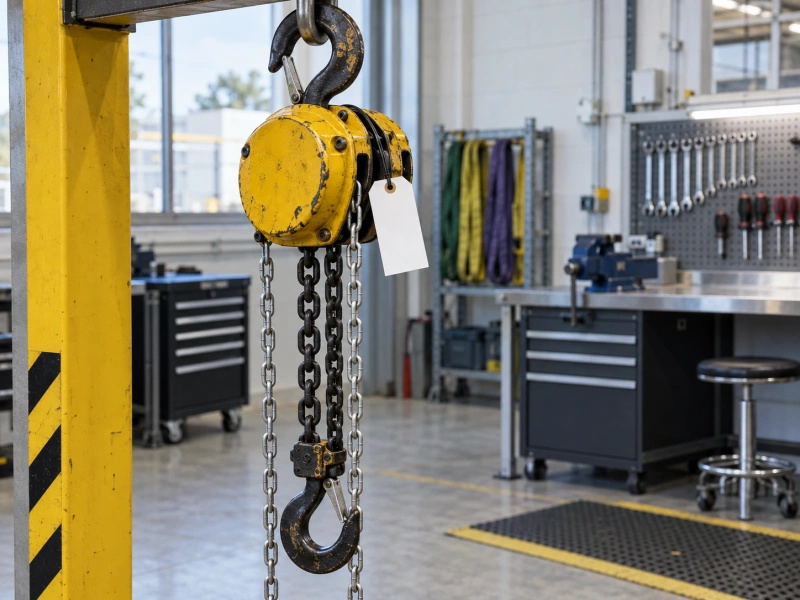
Stop operating the chain block when its condition or behavior is uncertain. Keep personnel clear of the load path. If a load is suspended, follow the site lifting plan and use competent personnel to place it in a safe condition; do not rely on a suspect hoist or work beneath the load. Prevent further use in accordance with the employer’s isolation and tag-out procedure.
Record the condition before cleaning, moving, or dismantling the hoist:
- Manufacturer, model, serial or batch number, rated capacity, and lift
- Location, suspension arrangement, load, and task at the time of the fault
- What the operator saw, heard, or felt, including the direction of travel
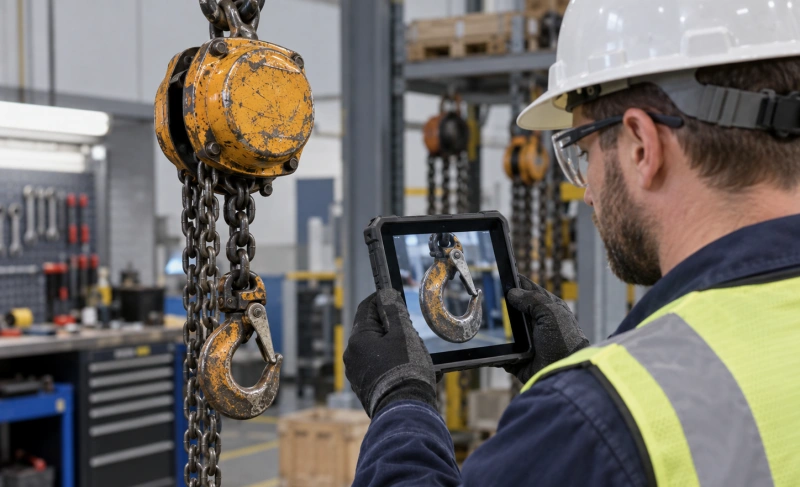
- Photographs of the nameplate, hooks, load chain, hand chain, housing, and any visible damage
- Recent inspection and maintenance history, plus any overload, impact, or environmental exposure
Conditions That Require Immediate Removal from Service
Do not continue operating the hoist if any of the following is found:
- The brake does not hold, the load drifts, or the hoist behaves unpredictably
- The load chain is cracked, gouged, twisted, kinked, stretched, severely worn, or corroded
- A hook is cracked, opened, twisted, excessively worn, heat-affected, or missing a required latch
- The hand chain or load chain jumps, binds, comes off its wheel or sheave, or will not travel freely
- The housing, suspension, fasteners, or load-bearing parts are cracked, loose, or deformed
- The nameplate or rated-capacity marking is missing or cannot be matched to reliable records
- The hoist has been overloaded, subjected to shock loading, exposed to fire, altered, or involved in an incident
These observations do not, by themselves, identify the internal cause. Use the exact manual and the chain block components guide to describe what is visible, then route the hoist for qualified assessment and repair.
Troubleshooting Without Unsafe Disassembly
The table below is intended for fault reporting. It does not authorize the user to open the hoist, adjust the brake, or replace a load-bearing component.
| Observed Symptom | Possible Areas to Assess | Safe Next Action |
| Hand chain will not move | Load condition, chain path, suspension alignment, obstruction, hand-chain wheel, gearing, or brake | Stop. Do not force the hand chain. Secure the load and work area, then arrange a model-specific assessment. |
| Load chain binds or jumps | Chain twist, damaged links, incorrect reeving, chain guide, load sheave, or contamination | Remove from service. Do not straighten, splice, grind, or otherwise modify the load chain. |
| Load drifts, or brake will not hold | Brake wear, contamination, damage, incorrect assembly, or another internal fault | Treat this as a critical defect. Do not adjust the brake under load or use a light-load check as approval for service return. |
| Grinding, clicking or rough travel | Chain engagement, bearings, gears, fasteners, housing alignment, or foreign material | Stop operation and record when the noise occurs. Arrange a qualified inspection. |
| Hook or latch damage | Overload, side loading, impact, wear, heat exposure, or corrosion | Remove from service and compare the measured condition with the manufacturer’s model-specific limits. |
| Excessive hand pull | Overload, poor alignment, chain condition, mechanical wear, or an unsuitable environment | Confirm the actual load and complete setup without operating a suspect hoist. Escalate any unresolved resistance for qualified assessment. |
Separate Maintenance from Repair
Routine owner maintenance may include external cleaning, corrosion control, and lubrication when the model-specific instructions assign those tasks to the user. Use only the lubricant type, lubrication points, quantity, and interval specified for the exact hoist. Do not apply lubricant to braking surfaces or use cleaning chemicals that could damage friction materials, finishes, or markings.
Use the chain block maintenance guide for preventive work and the chain block inspection checklist for condition checks. Work involving housing removal, brake components, gears, bearings, shafts, hooks, load sheaves, load-chain replacement, or structural components is repair work and requires a qualified or authorized repairer working to the correct technical instructions.
Choose a Qualified Repair Route
The owner should define who is authorized to repair the hoist under the applicable standard, local law, and employer program. Depending on the model and market, this may be the manufacturer, an authorized service center, or a qualified lifting-equipment technician.
The repairer should have the current manual, parts information, suitable measuring equipment, controlled test facilities, and the competence and authorization to determine whether the hoist can return to service.
Provide the repairer with a complete work package:
- Clear nameplate photographs and exact model, serial, or batch identification
- The fault report, incident history, and most recent inspection record
- The current operating, maintenance, and repair instructions for the model
- The applicable workplace, contractual, and destination-market requirements
- Records of prior repairs, modifications, and replacement parts
Control Replacement Parts and Load Chain
Use only parts that the manufacturer or responsible technical authority identifies as compatible with the exact model and configuration. Similar dimensions, a familiar chain grade, or a matching housing shape do not establish compatibility.
A hoist load chain is a model-specific component matched to its load sheave. Do not weld, heat, straighten, grind, or splice damaged links. Do not mix sections of old and new chain. When replacement is authorized, install the complete specified load chain using the model-specific procedure, correct orientation, and reeving. Replace associated components only when required by the technical instructions or inspection findings.
Document the Repair
A repair record should identify what was found, what was changed, and who accepted the work. Include:
- Hoist identification, owner, location, and date received
- Inspection findings and measurements compared with cited acceptance limits
- Parts removed and installed, including part numbers and traceability where required
- Repair procedures and document revisions used
- Technician identity, qualifications or authorization, and repair date
- Inspection and test results, test-equipment identification, and the acceptance decision
- Any restrictions, next inspection date, or required follow-up action
Inspect and Test Before Return to Service
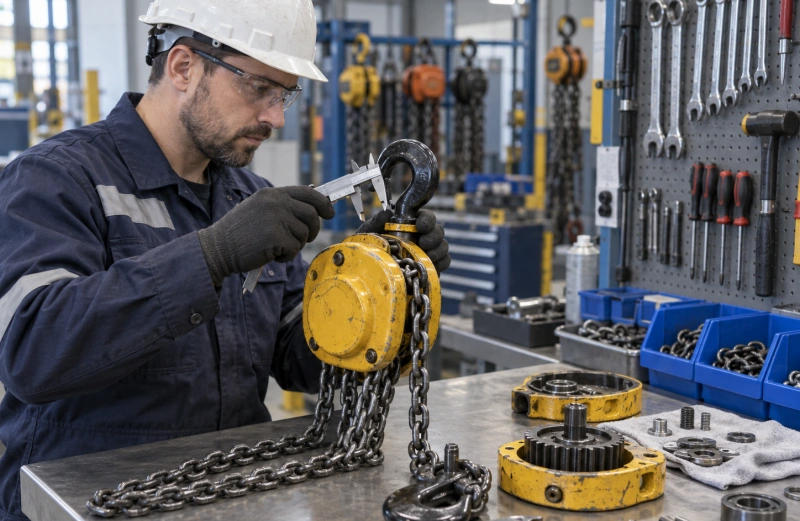
Completion of the repair does not, by itself, authorize service return. A designated or qualified person should inspect the assembled hoist and verify identification, chain travel and reeving, hook and latch condition, fasteners, lubrication, and brake operation in accordance with the exact instructions and applicable requirements.
The required operational or load test depends on the repair, model, applicable standard, owner program, and jurisdiction. Do not publish a universal test-load percentage or treat a light-load trial as sufficient. Testing must use a controlled setup, suitable test equipment, an exclusion zone, and documented acceptance criteria. Record the results before the tag-out is removed and the hoist is returned to service.
ASME B30.16 includes provisions for the construction, installation, operation, inspection, testing, and maintenance of overhead underhung and stationary hoists, including hand-chain-operated hoists. ASME HST-2 addresses performance requirements for hand-chain-operated chain hoists.
BS EN 13157 includes hand chain blocks within its scope. The applicable contract requirements and destination jurisdiction determine which standards apply; citing a standard does not demonstrate product conformity.
Decide Whether Replacement Is the Better Option
Replacement may be more appropriate when any of the following applies:
- The model or rated capacity cannot be identified with confidence
- The manufacturer no longer supports the model or approved safety-critical parts are unavailable
- The housing, suspension, or multiple safety-critical components are severely damaged
- Unauthorized modification, fire, chemical exposure, or overload has made the repair basis uncertain
- The combined cost of repair, inspection, and testing approaches the cost of a suitable, documented replacement
When replacement is selected, compare the current Powerful Machinery chain block range by rated capacity, lift, headroom, suspension, hand pull, operating environment, and required documentation. Send a nameplate photograph and the application details; a visually similar hoist is not necessarily an equivalent replacement.
Chain Block Repair FAQs
Can I Repair a Chain Block Myself?
Perform only tasks that the exact model instructions assign to the owner and that your workplace authorizes. Internal repair, brake work, load-chain replacement, and replacement of safety-critical components require the specified procedure, correct parts, and a qualified or authorized repairer.
What Should I Do When a Chain Block Will Not Lift?
Stop using the hoist and remove it from service. Do not pull harder or exceed rated capacity. Record the load, setup, and symptoms; check only the external items permitted by the instructions; and arrange a qualified assessment if the cause cannot be safely resolved.
Can a Damaged Load Chain Link Be Repaired?
No. Do not weld, heat, straighten, grind, or splice a damaged hoist load chain. Replace it only with the complete manufacturer-specified load chain and follow the model-specific installation procedure.
Does a Light-Load Test Make a Repaired Hoist Safe?
No. A light-load check may reveal an obvious operating problem, but it does not replace the inspection and testing required for the repair. A qualified person must define and document the return-to-service checks in accordance with the applicable instructions and requirements.
How Often Should a Chain Block Be Inspected?
There is no single interval that applies to every hoist and workplace. Inspection frequency depends on service, environment, condition, operating history, manufacturer instructions, the employer’s program, and governing requirements. Use the retained inspection guide to organize the review without replacing those requirements.
What Information Should I Send for Technical Support?
Send the model, serial or batch number, rated capacity, lift, a nameplate photograph, a description of the fault, incident history, the latest inspection record, and clear photographs of the affected area. Contact our technical sales team for model identification, replacement-hoist selection, or available product documentation. Repair authorization and parts availability must be confirmed for the exact model.