Choosing a D shackle for towing starts with the connection, not the shackle’s appearance. A trailer safety-chain connection, a steady tow, and a vehicle recovery pull involve different loads and requirements. First identify the application and the rating required by the relevant equipment instructions and local rules.
Then check the exact shackle’s Working Load Limit (WLL), dimensions, fit, and intended loading direction. Confirm that its manufacturer permits the proposed use. If the loading conditions or product instructions are unclear, resolve them before ordering or using the connection.
Browse the D shackle range to identify candidate configurations. Treat the listed specifications as a starting point for a model-specific inquiry.
What Is a D Shackle for Towing?
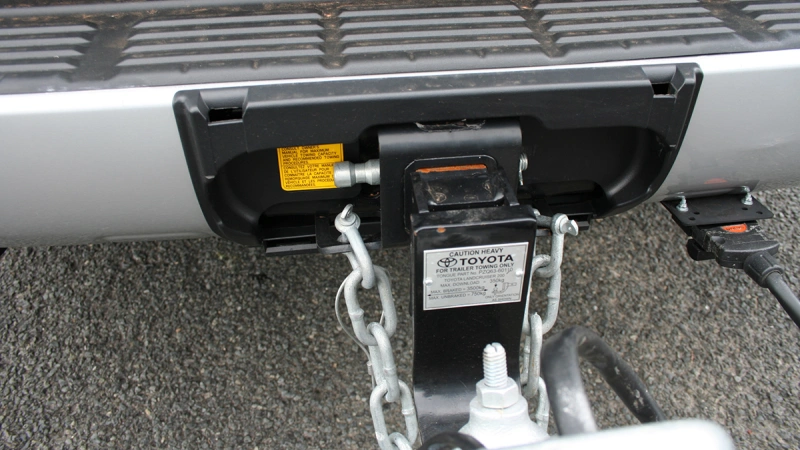
A D shackle, also called a Dee or chain shackle, has a relatively narrow, D-shaped body closed by a removable pin. Its shape can suit a connection in which the load stays aligned and the attached fitting seats correctly. The shape does not establish that a particular model is suitable for road towing, winching or vehicle recovery.
A listing for lifting gives you a rating to examine, but you still need the manufacturer’s instructions for the proposed use.
If you need the general terminology and pin styles first, see what a D shackle is. This guide focuses on choosing the connection for a defined towing task.
How to Choose a D Shackle for Towing
Step 1: Define the Application
Tell the supplier what the shackle will connect and how it will be loaded. A trailer safety chain is a secondary connection if the coupling separates. In a steady tow of a disabled vehicle or industrial equipment, the towing connection carries the pulling load. Winching and vehicle recovery may add changes in direction and force.
A kinetic or snatch recovery can impose rapid peak loads. Each application needs its own equipment instructions.
For a trailer, record its Aggregate Trailer Mass (ATM), if applicable, the safety-chain specification, the towbar attachment details, and the vehicle or trailer maker’s instructions. For industrial towing, supply the equipment drawings, expected loading, and operating procedure. State whether the connection may be pulled at an angle.
Step 2: Establish the Required Rating and Check WLL
WLL is the maximum load assigned to a shackle for use under its stated conditions. Check the rating on the shackle against the current specification for that model and the requirements for your connection. Do not derive a required shackle WLL from trailer mass alone. Road authority guidance and the vehicle, trailer and towbar instructions may specify how to select the connection.
Check the chain, tow point and other fittings as well as the shackle. A rated shackle cannot compensate for an unsuitable component elsewhere in the assembly. Legible markings and the current product specification matter more than a “heavy duty” label or a large body. If the proposed loading differs from the manufacturer’s stated conditions, ask for model-specific guidance.
Step 3: Measure Body, Pin and Connection Fit
Record the body diameter and the pin dimensions separately. Measure the tow-point hole or slot, the chain link’s inside dimensions and bar diameter, and the space needed for the complete pin and retainer. Check which component will bear on the pin and which will sit against the shackle body.
Neither should bind or wedge as the connection moves. If assembly requires hammering or a substitute pin, select another configuration.
Use the drawing for the exact series. Our guide to measuring a shackle explains common reference points. A pin can pass through a hole yet leave too little room for full engagement; a link can enter the shackle yet bind as it moves. Allow for coating and manufacturing tolerances using a confirmed drawing, not a guessed clearance. Send a dimensioned sketch or caliper photographs if the attachment is unusual.
Step 4: Check Load Direction and Pin Arrangement
A Dee shackle generally suits a relatively straight load path. Rotation, an angular pull, or a wide fitting can change where the load bears on its body and pin. If the connection cannot stay aligned, check the exact model’s instructions. Do not apply a generic allowance for side loading.
Use the correct pin for the model. Check its full engagement and any required nut or retainer. Screw-pin and bolt-type safety-pin arrangements have different retention details; follow the manufacturer’s instructions for the intended application. A higher WLL does not make a loose or mismatched pin acceptable.
Step 5: Confirm the Exact Model’s Permitted Use
Ask whether the exact model is permitted for the towing connection and its operating conditions. Describe the application and request instructions covering loading direction, assembly, inspection and environment. A catalogue lifting WLL does not, by itself, establish suitability for a particular towing or recovery method.
You can compare the shackle product range before requesting a model-specific quote. Include the intended use in your inquiry.
WLL, Proof Load and Breaking Strength Are Different Values
WLL is the assigned limit for use under stated conditions. Proof load is a load applied in a specified test when the product specification or test record calls for it. Minimum breaking load (MBL) is a stated lower limit for breaking load under defined test conditions. A quoted “breaking strength” needs its own definition and supporting evidence. None of these test or failure-load figures should be used as the WLL.
The supplied Powerful catalogue lists WLL by size for the Grade S Dee Shackle range, but it does not list proof load or breaking load for that range. We therefore give no proof-load, MBL or safety-factor figure for it. If your purchase specification requires test data, ask what documentation is available for the quoted model and batch. Do not estimate breaking load by multiplying the listed WLL.
The other parts of a towing assembly also need suitable ratings and permitted connection methods.
Powerful Grade S Dee Shackle Size Reference
Powerful Machinery’s catalogue lists Grade S Dee Shackles AS2741 Standard. These selected entries reproduce the catalogue’s WLL and P, B and A dimensions. The drawing places P at the body and B near the pin, but the exact measurement points and tolerances need confirmation before you use these figures to check a mating hole or clearance. The table does not establish suitability for a particular towing or recovery operation.
| Nominal size (mm) | WLL (t) | P (mm) | B (mm) | A (mm) |
| 6 | 0.5 | 6 | 8 | 12 |
| 8 | 0.75 | 8 | 10 | 13 |
| 10 | 1.0 | 10 | 11 | 17 |
| 11 | 1.5 | 11 | 13 | 18 |
| 13 | 2.0 | 13 | 16 | 21 |
| 16 | 3.2 | 16 | 19 | 27 |
| 19 | 4.7 | 19 | 22 | 32 |
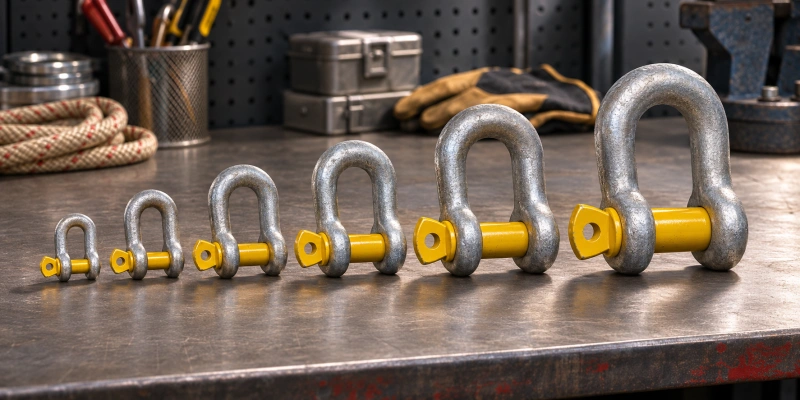
For example, the 10 mm entry lists P = 10 mm, B = 11 mm, and WLL = 1.0 t. These separate dimensions show why a “10 mm shackle” description is insufficient to verify the pin and opening fit. Check the measurement points against the current drawing. The Grade S Dee Shackle product page has the full size range, but neither its standard reference nor the catalogue table is a batch certificate or an approval for a particular tow.
If you have a candidate size, send its WLL and your connection dimensions for a fit review before ordering.
D Shackle vs Bow Shackle for Towing
| Selection factor | D or Dee shackle | Bow or anchor shackle |
| Geometry | Narrower crown and more compact body | Rounded, wider crown with more internal space |
| Connection question | Will the fitting seat in an aligned, narrow opening? | Does the connection need more room for its geometry? |
| Load direction | Check the exact model’s instructions | Check the exact model’s instructions |
| Decision basis | WLL, fit, pin security and permitted application | WLL, fit, pin security and permitted application |
The bow’s wider crown may accommodate a larger fitting, while a Dee can fit a narrower, aligned connection. Neither geometry alone establishes a higher rating or permits side loading, multiple attachments, or dynamic recovery. Compare each model’s WLL, dimensions, pin arrangement, and instructions for the intended assembly.
For a closer look at the shapes, see bow shackle vs D shackle.
Trailer Towing and Vehicle Recovery Need Separate Checks
A trailer safety chain serves as a secondary connection if the coupling separates. In a steady tow or a winch pull, the connector may carry the main pulling load. Kinetic recovery can produce rapid, changing forces. Check the instructions for the actual operation; a component selected for a trailer safety chain should not automatically be transferred to a recovery setup.
For vehicle recovery, check the shackle maker’s stated applications, the vehicle’s rated recovery point, and the instructions for the strap or chain and the recovery method. A lifting WLL or a similar appearance to recovery hardware is insufficient.
If you cannot verify the proposed arrangement, use equipment documented for that operation. The tow hook vs shackle comparison explains the connection choices; neither fitting makes an unsuitable attachment point acceptable.
D Shackles for Caravan Towing in Australia
In Australia, start with the trailer’s ATM and the rules where it will be used. The Australian Government’s Vehicle Standards Bulletin 1 Revision 6 explains applicable ADR requirements for trailers with an ATM of 4.5 tonnes or less. State and territory authorities provide further road-use guidance.
For example, Queensland’s towing equipment guidance permits a shackle to connect a safety chain to a towbar when it is fit for purpose and compatible with the chain in strength and size. Its selection table includes a 10 mm Grade S D shackle with 1.0 t WLL for trailers up to 3,500 kg ATM, for which two safety chains are specified. This is a Queensland example, not an approval of a particular Powerful product or a rule for every market.
AS 2741 is a shackle product standard. A catalogue heading containing “AS2741 Standard” does not prove that a quoted batch has a test certificate or that the whole towing assembly meets local requirements. Confirm the model’s markings, available documentation, chain and towbar fit, and current local guidance.
Check Fit and Condition Before Use
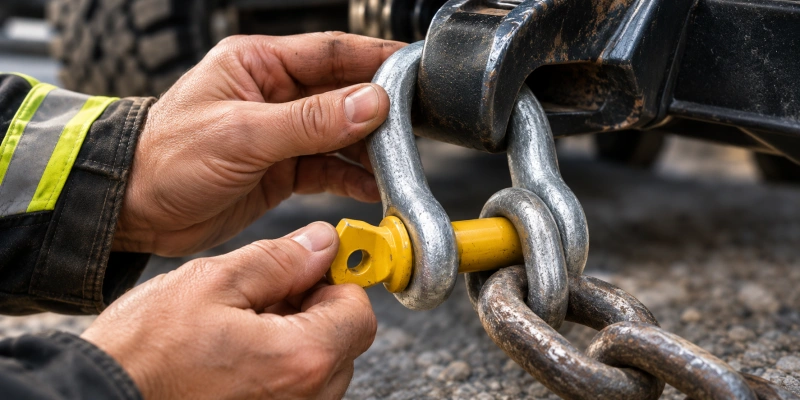
Before use, check the shackle identification, body, correct pin, and retaining parts. Look for cracks, distortion, excessive wear, corrosion in a load-bearing area, damaged threads, and illegible markings. Do not straighten a deformed body or fit an unrelated pin. Follow the manufacturer’s removal criteria and the applicable vehicle or site procedure.
Check that the pin is fully engaged and retained as specified, the chain or lug seats correctly, and the assembly can move as intended without binding. Inspect the chain and attachment point too. Recheck the fit and ratings after any repair or modification that changes the connection.
Use the shackle inspection checklist for a fuller component review. Its general lifting discussion does not replace the vehicle or towing equipment instructions for this application.
What to Send for a D Shackle Quote
For a quote, describe the application: trailer safety chain, steady tow, winching, vehicle recovery, or industrial towing. Give the required WLL or applicable rating basis and any equipment-maker instructions. Include the chain bar diameter and link opening; the tow-point hole or slot, lug thickness and available room for the pin and retainer; and the likely loading direction. If you have an existing shackle, send its model, markings, and measurements.
Add the quantity, destination market, preferred finish, and any marking, packaging, or documentation requirements. We can then confirm what is available for the quoted model. Send your dimensions and application details and identify anything you still need measured or confirmed.
FAQs
What size D shackle do I need for towing?
There is no universal size. Check the requirements for the application, then compare the model’s WLL and dimensions with the chain and attachment point. For a trailer, check its ATM and the relevant road authority and equipment instructions.
What WLL should a towing shackle have?
Follow the applicable rating guidance and check the exact model’s WLL and conditions of use. Trailer ATM alone is not a universal formula for the required shackle WLL.
What is the difference between WLL and breaking strength?
WLL is the assigned limit for use under stated conditions. Breaking strength describes a failure-load figure, which must be defined and supported for the product. Do not treat it as the WLL or derive it from Powerful’s catalogue rating.
Does D shackle size refer to the body or the pin?
The Grade S table lists a 10 mm nominal size with P = 10 mm and B = 11 mm. The drawing shows different measurement locations. Confirm the current drawing and pin diameter before checking a mating hole.
How do I know if a D shackle will fit my tow point or chain?
Check the pin against the hole or link, then check the shackle opening, lug thickness, movement, and room for full pin engagement. A forced or binding fit is unsuitable. Request the model drawing if a dimension is unclear.
Is a D shackle better than a bow shackle for towing?
Compare the fittings and each model’s rating and instructions. A D shackle is narrower; a bow shackle has a wider crown. Neither shape alone establishes suitability for the tow.
Can a lifting D shackle be used for vehicle recovery?
A lifting WLL alone does not establish recovery suitability. Check the shackle, vehicle recovery point and recovery equipment instructions for the proposed method.
Are D shackles required for caravan towing in Australia?
There is no blanket requirement to use a D shackle for every caravan. Safety chains need a suitable connection to the towbar; Queensland, for example, permits a compatible, fit-for-purpose shackle. Check the current rules where you tow and the trailer, chain, and towbar requirements.