A chain hoist can lift only up to the rated load or working load limit (WLL) shown on its nameplate. There is no single capacity that applies to every chain hoist. The allowable load depends on the exact model, suspension, lifting arrangement, and approved operating conditions.
The total suspended load applied to the bottom hook must include the payload and everything carried below the hook, such as a lifting beam, clamp, sling, shackle or other attachment. Do not use test load, chain strength, motor power or a design factor as permission to exceed the marked rating.
The Short Answer
If the nameplate states 1 t, the hoist is rated for no more than 1 metric tonne, or 1,000 kg, in the configuration described by its manual. A 2 t unit is rated for no more than 2,000 kg. Confirm whether the manufacturer uses metric tonnes, U.S. short tons, or another unit before converting the value.
| Marked Capacity | Equivalent Mass | Approximate Pounds |
| 0.5 metric tonne | 500 kg | 1,102 lb |
| 1 metric tonne | 1,000 kg | 2,205 lb |
| 1.5 metric tonnes | 1,500 kg | 3,307 lb |
| 2 metric tonnes | 2,000 kg | 4,409 lb |
| 3 metric tonnes | 3,000 kg | 6,614 lb |
| 5 metric tonnes | 5,000 kg | 11,023 lb |
| 10 metric tonnes | 10,000 kg | 22,046 lb |
These conversions explain the units only. They are not a Powerful Machinery product range and do not replace the nameplate or approved datasheet for the hoist being used.
What Do Rated Load and WLL Mean?
Rated load and working load limit (WLL) are capacity terms used to identify the maximum load permitted for a specific hoist under its stated conditions. The nameplate provides the quickest reference, while the manual and product datasheet define the complete configuration and operating limits.
For a manual unit, the chain block mechanism uses a hand chain, reduction gears, a load sheave, and a mechanical load brake. Powered chain hoists use a motor or air drive, but their allowable load still comes from the marked rating of the complete hoist, not from drive power alone.
Do not confuse the following values with usable lifting capacity:
- Test load. A manufacturer may test a hoist above its rated load under a controlled procedure. That test value is not an operating limit.
- Breaking strength. The force at which a component may fail is not an allowable load for the assembled hoist.
- Design factor. This is a product-design parameter associated with the applicable design criteria or standard. It is not spare capacity for the operator.
- Hand pull or motor power. These describe input effort or drive characteristics. They do not override the nameplate rating.
How to Calculate the Load Applied to the Hoist?
Use arithmetic to total the suspended load. Do not use a formula to invent the hoist rating.
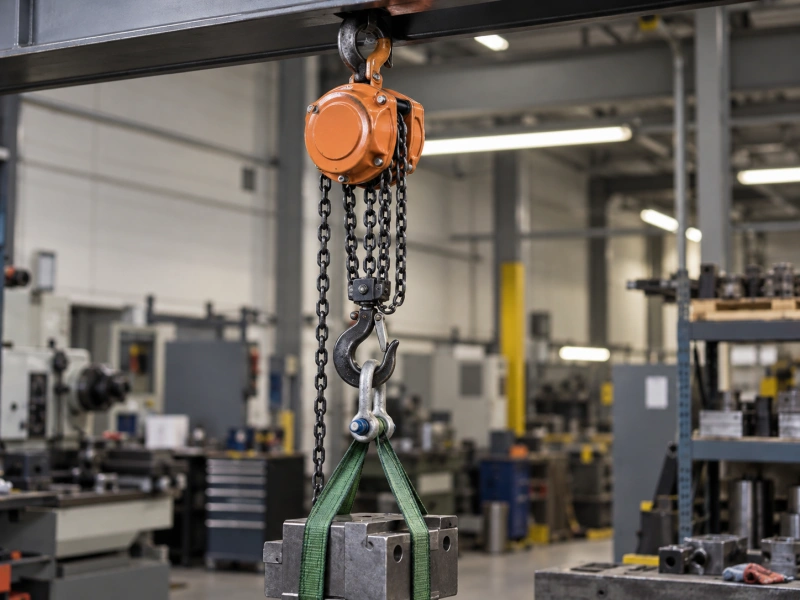
Total suspended load = payload + below-the-hook lifting device + slings + shackles + other items carried by the bottom hook
Suppose a machine weighs 920 kg, a lifting beam weighs 55 kg, and the slings and shackles weigh 25 kg. The total suspended load is 1,000 kg. A hoist marked 1 t meets the basic load rating for that verified total only when the model, configuration, and operating conditions are suitable.
It leaves no allowance for weighing uncertainty, future changes, or a heavier attachment. If any input is uncertain, determine it before the lift or select a higher-rated model through the responsible lift plan. Do not add an arbitrary percentage and call it a universal safety factor.
Items above the hoist, such as the top suspension, trolley, beam, or supporting structure, are not part of the suspended load at the bottom hook. They still must support the hoist itself and all forces imposed by the complete lifting arrangement, so their capacities require separate verification.
How to Choose the Right Chain Hoist Capacity?
- Identify the heaviest load that will actually be lifted. Use a verified weight from drawings, a scale, shipping data, or another reliable source.
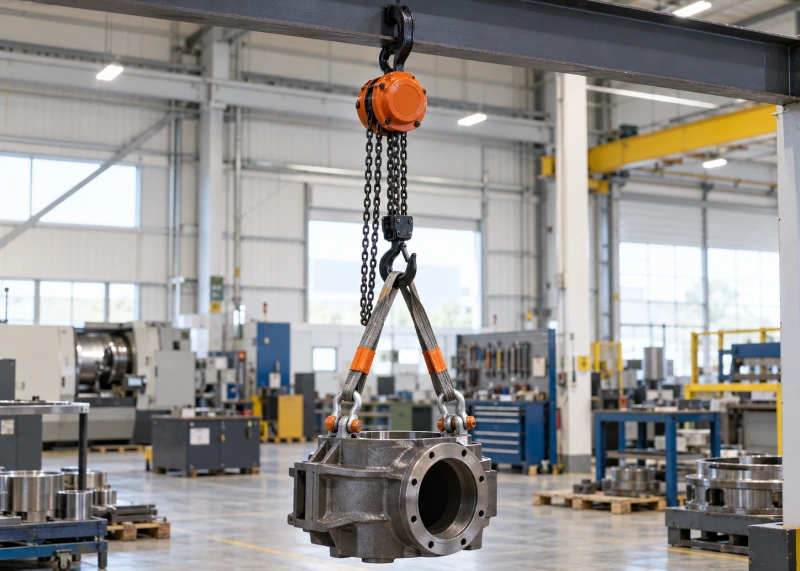
- Add every below-the-hook component. Include lifting beams, clamps, magnets, slings, shackles, and special fixtures.
- Choose a hoist whose marked rated load is at least the known total. If the load weight may change, select for the maximum credible total defined by the lift plan.
- Confirm the hoist type and intended direction of use. Standard hand chain blocks are generally intended for vertical lifting of freely suspended loads.
- Check lift height, headroom, hand-chain drop or control position, suspension, hook dimensions and available travel.
- Match operating frequency and environment to the manufacturer’s rating. Temperature, corrosion, dust, moisture, or a hazardous location may require a different model or approved option.
- Verify the support, trolley, and below-the-hook equipment independently. The lowest applicable rating limits the complete lifting system.
- Review the nameplate, manual, inspection status, and required documentation before use. A missing or unreadable capacity marking is a reason to remove the hoist from service.
For manual vertical-lifting applications, once the required capacity is established, compare the 0.5–10 tonne HSZ-T hand chain block against the required lift, headroom, suspension method, and operating conditions before final selection.
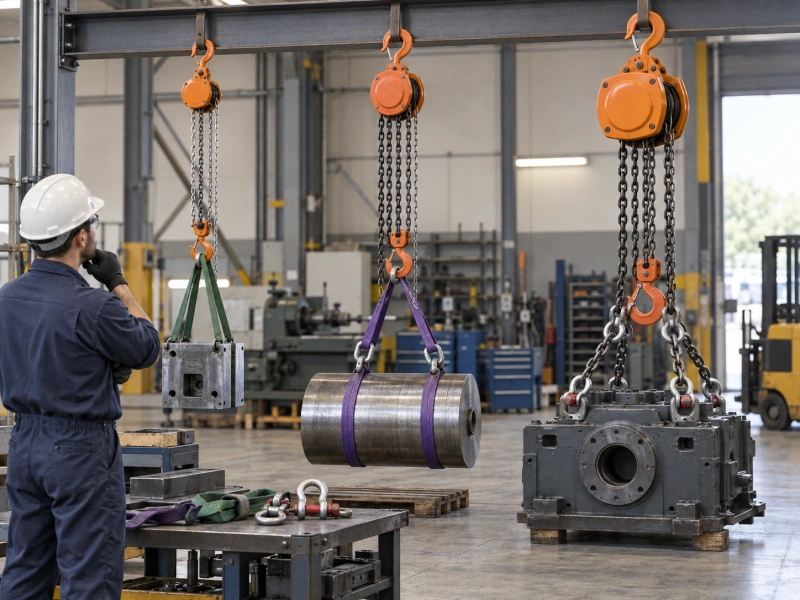
Capacity Is Not the Same as Lifting Speed or Operator Effort
A higher capacity does not automatically mean a faster lift or lower operating effort. On a manual chain block, gearing and the number of load-chain falls affect how much hand chain must move and how much pull the operator must apply.
On a powered hoist, motor rating, reduction, speed, and duty classification work together. Compare hand pull, lifting speed, and duty data for the exact model after the required capacity is known.
Start with the lifting task, then compare manual hoist types or review available electric chain hoists when operating frequency, speed, or control method changes the selection.
Does Lift Height Reduce Chain Hoist Capacity?
A longer lift does not automatically reduce the marked capacity by a fixed percentage. It changes chain length, chain weight, available headroom, travel time, and handling requirements. The manufacturer must approve the requested lift and chain configuration. The supporting structure must also carry the hoist, the suspended load, and the installed equipment.
Never shorten, splice, or extend the load chain with unapproved components. If the standard lift is too short, order the required lift from the manufacturer or use an approved conversion procedure for the exact model.
Can Two Chain Hoists Lift Twice as Much?
Do not add two nameplate ratings and assume the result is safe. Two hoists rarely share a load perfectly. The center of gravity, sling geometry, support movement, and operator timing can place more load on one hoist than the other. Some manufacturer instructions require each hoist used in a two-hoist lift to have a WLL equal to or greater than the entire load.
A multi-hoist lift requires a planned load share, compatible equipment, controlled operation, and the approval required by the worksite. If the load distribution cannot be established, stop and have a competent person develop the lift plan.
Can a Chain Hoist Hold a Load in the Air?
A correctly functioning hoist brake controls and holds the load during normal lifting and lowering. That does not make a hoist a permanent support. Do not leave a suspended load unattended or keep it suspended for an extended period unless the manufacturer and the applicable procedure explicitly allow the arrangement. Set the load on a stable support when the lifting task is complete.
Conditions That Do Not Justify Derating
Operators sometimes try to assign an informally reduced capacity to a damaged hoist or an unsuitable lifting arrangement. That is not a valid repair or risk-control measure. Remove the hoist from service when its condition, identification, or operation is doubtful.
- A damaged, stretched, twisted or corroded load chain is not safe at a guessed lower load.
- A deformed hook, missing latch, slipping brake, or unreadable nameplate requires inspection or repair, not informal derating.
- Side pulling, shock loading, tip loading, and using the load chain as a sling remain prohibited unless the exact equipment is designed and approved for that use.
Use the chain block inspection checklist before operation and follow the manufacturer’s inspection program. The chain block maintenance guide explains preventive care, while repairs belong to qualified personnel.
Chain Hoist Capacity Selection Table
| Selection Input | Question to Answer | Why It Matters |
| Total Suspended Load | What is the verified weight of the payload and all below-the-hook equipment? | The total must not exceed the marked rated load. |
| Capacity Units | Does the nameplate use kg, metric tonnes, U.S. tons or pounds? | A unit error can overload the hoist. |
| Lift and Headroom | How far must the hook travel, and how much vertical space is available? | Confirms the required chain length and physical fit. |
| Suspension and Support | How is the hoist attached, and what does the structure support? | Every component and support requires an adequate independent rating. |
| Frequency and Speed | How often must the load move, and at what speed? | Guides manual-versus-powered selection and duty requirements. |
| Environment | Are temperature, corrosion, dust, water or hazardous materials present? | Does the nameplate use kg, metric tonnes, U.S. tons, or pounds? |
| Documentation | Which standards, test records and certificates does the project require? | Requirements depend on the model, destination, and application. |
FAQ
How Much Can a Chain Block Lift?
A chain block can lift no more than the rated load or WLL shown on its nameplate. Chain blocks are available in different capacities, so the exact answer comes from the specific model. Compare available manual chain block models only after calculating the complete suspended load.
See the manual chain block range for product selection. Confirm all figures against the approved datasheet supplied with the quotation.
Is a One-Ton Chain Hoist Rated for 2,000 or 2,205 Pounds?
It depends on the unit used by the manufacturer. One U.S. short ton is 2,000 lb. One metric tonne is 1,000 kg, approximately 2,205 lb. Read the nameplate and manual instead of assuming that the word “ton” means the same unit in every market.
Should I Add a Safety Margin When Choosing Capacity?
The marked rated load must never be exceeded. If the load weight is uncertain, may increase, or includes variable attachments, choose a capacity that covers the maximum credible total. Any project-specific allowance must come from the applicable lift plan, standard, and manufacturer guidance, not from a universal percentage copied from another hoist.
Can I Calculate Hoist Capacity from Chain Size or Motor Power?
No. Chain dimensions and motor power are only parts of a complete system. Gears, load sheave, brake, hooks, frame, reeving, suspension, controls, and duty rating also matter. Use the rating assigned to the complete hoist by its manufacturer.
Does a Longer Load Chain Increase Capacity?
No. Additional chain increases available lift; it does not increase rated load. The exact model must be approved for the requested lift, and the support arrangement must account for the complete installation.
What If the Hoist Will Not Lift the Rated Load?
Stop. Do not apply extra force, use a cheater bar, or adjust the brake under load. Lower or secure the load safely if possible, remove the hoist from service, and arrange inspection in accordance with the manufacturer’s procedure.
Follow the chain block operating guide for the normal operating sequence and removal-from-service boundaries.
Request the Correct Hoist Configuration
Send Powerful Machinery the verified suspended load, required lift, headroom, suspension method, hook or connection dimensions, operating frequency, environment, power supply where applicable, destination, and required documents. We can then identify a suitable configuration for quotation. Final selection must use the approved product data and instructions supplied for that model.
If the application could use either a chain or wire rope system, review the chain hoist versus wire rope hoist comparison before preparing the inquiry.