Knowing how to use a manual hoist safely starts before you pull a hand chain or move a lever. First, identify the hoist type, confirm its rated capacity and intended direction of load movement, inspect the hoist and supporting system, align the load path, and then move the load with smooth, controlled input. The instructions and markings for the exact hoist always take priority over a general guide like this one.
This guide covers the two manual hoist families most relevant to industrial lifting: hand chain hoists, often called chain blocks, and lever hoists. If you are still deciding which operating method fits the job, start with our chain block and lever hoist comparison.
Which Manual Hoist Are You Using?
The first safety step is to identify the equipment correctly. A hand chain hoist and a lever hoist are both manual hoists, but they are operated differently and are not interchangeable for every task.
| Manual hoist type | Operator input | Typical Application | Detailed page |
| Hand chain hoist/chain block | Continuous hand-chain operation | Controlled vertical lifting from a suitable overhead support | Hand chain hoists and chain blocks |
| Lever hoist | Ratcheting lever strokes | Lifting, pulling, tensioning, or positioning when the exact model permits the intended application | lever hoists |
A standard hand chain hoist is normally selected for vertical lifting. Do not assume it can be used for pulling, angled work, or non-vertical loading. A lever hoist may be designed for lifting, pulling, or tensioning, but the permitted direction, anchor arrangement, and load path must be confirmed in the instructions for the exact model.
Before You Use a Manual Hoist
1. Confirm the identity and rating. The model, rated capacity, and warning information should be legible. If the nameplate or identification is missing and you cannot positively identify the hoist and its limits, remove it from service until it has been assessed.
2. Know the total suspended load. Include the lifted item and any below-the-hook attachments or rigging that contribute to the suspended load. Never exceed the rated capacity marked for the exact hoist.
3. Confirm the intended task and direction. Decide whether the job is vertical lifting, pulling, tensioning, or positioning. Make sure the hoist model is intended for that task.
4. Check the suspension or anchor. The supporting structure, beam attachment, trolley, shackle, or anchor must be suitable for the total load and intended direction of force. The hoist’s rated capacity alone does not prove that the support is adequate.
5. Check the hoist and load path. Look for damage, deformation, corrosion, a twisted or damaged load chain, hook damage, missing parts, abnormal operation, or anything outside the manufacturer’s acceptance criteria. Keep the travel path and landing area clear of people and obstructions.
For a fuller inspection program, use our manual hoist inspection guide. A quick pre-use check does not replace formal inspection carried out at the intervals specified by the manufacturer, applicable standard, employer, or site procedure.
How to Use a Manual Hoist Step by Step
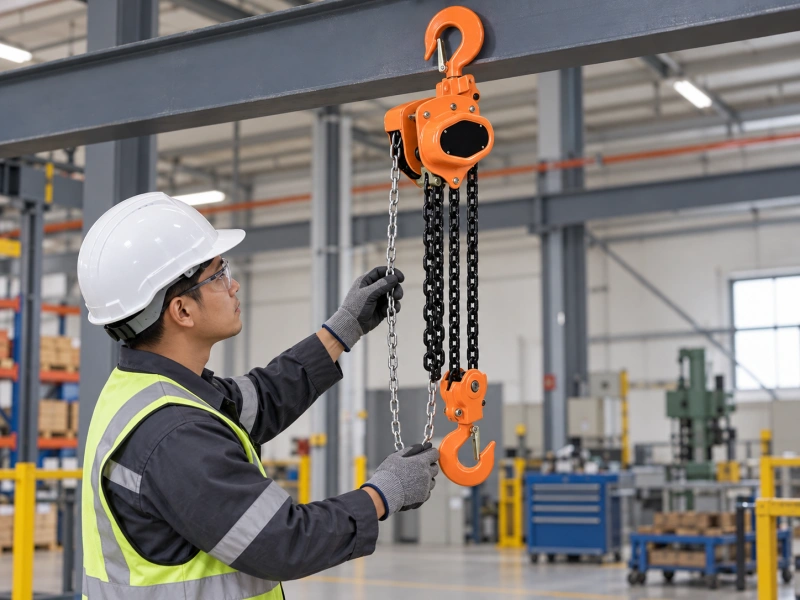
1. Confirm the Hoist, Load, and Intended Direction
Read the instructions for the exact model before first use. Verify the rated capacity, required lift or reach, and intended direction of movement. If the planned application falls outside the instructions, stop and select equipment designed for that task.
2. Inspect the Hoist and Supporting System
Check the suspension, housing, hooks, latches, load chain, fasteners, and operating mechanism. Confirm that the load chain is correctly seated and free from twists. If the brake slips, the chain binds, a hook is damaged, the housing is cracked, or the hoist behaves abnormally, remove it from service, identify it to prevent use, and have it inspected through an authorized or qualified process.
3. Attach the Hoist to a Rated Support or Anchor
Seat the upper hook or suspension connection correctly. Do not load a hook on its tip or latch. Verify that the support and connecting hardware are suitable for the total load and intended direction of force.
4. Connect and Align the Load
Attach the lower hook to an approved lifting point or suitable rigging. Seat the load or rigging in the hook saddle, and make sure the latch is closed where fitted. Keep the intended line of force aligned through the suspension or anchor, hoist body, and load hook. Avoid side loading the hoist body or hooks.
5. Take Up Slack and Make a Controlled Trial Movement
Take up slack gradually. Move or raise the load only enough to confirm that it is balanced, the rigging is seated, the support is stable, the chain is tracking correctly, and the brake holds as intended. If anything shifts or behaves unexpectedly, return the load to a safe supported condition and correct the setup before continuing.
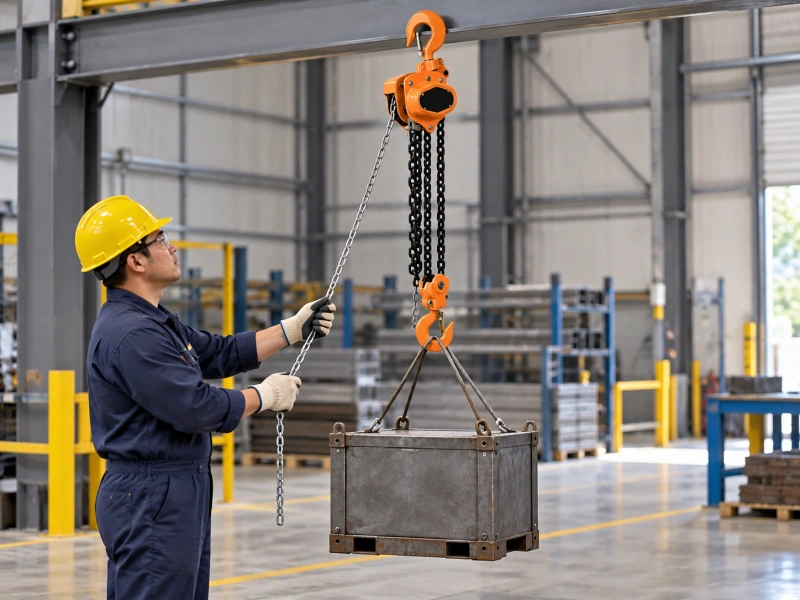
6. Lift, Pull, or Position with Smooth Input
Apply steady force to the hand chain or use controlled lever strokes. Do not shock-load the hoist, force a jammed mechanism, or add a pipe or other extension to a lever handle. Keep hands, clothing, and other objects clear of moving chains and mechanisms.
7. Lower and Land the Load
Lower the load smoothly onto a stable landing area. Make sure the load is fully supported before releasing the hoist or removing rigging. Do not create slack until the load is secure.
8. Complete a Post-Use Check
After the load is landed, look for new damage, unusual wear, contamination, or abnormal operation. Clean, lubricate, and store the hoist only as specified by the manufacturer. If the hoist has been exposed to unusual conditions, subjected to impact or overload, or has malfunctioned, remove it from service for evaluation before reuse.
Hand Chain Hoist vs Lever Hoist Operation
Using a Hand Chain Hoist
A hand chain hoist uses a separate hand chain to rotate the internal gearing and move the load chain. For normal vertical lifting, keep the hoist directly above the load and pull the hand chain with a steady motion. Do not use the hand chain as rigging, knot or twist the load chain, or use the hoist for a non-vertical task unless the manufacturer specifically permits it. For the chain-block-specific workflow, see the chain block operating guide.
Using a Lever Hoist
A lever hoist moves the load in small increments as the operator strokes the handle. Set the direction selector as instructed for the model, keep the load path in line, and make sure the operator has sufficient clearance for the full lever stroke. Free-chaining or unloaded chain adjustment, where fitted, must be used only as described by the manufacturer and must not be treated as a loaded operating mode. Do not extend the handle for extra leverage. For model-specific operating details, use the lever chain hoist operating guide.
Stop Using the Hoist If You See These Conditions
- The rated-capacity marking or identification information is missing or unreadable, and the hoist cannot be positively identified.
- The load chain is twisted, damaged, severely corroded, deformed, or does not feed correctly through the hoist.
- A hook, latch, suspension component, housing, or connection is cracked, bent, distorted, loose, or otherwise outside the manufacturer’s acceptance criteria.
- The load creeps or slips when the operating input stops, or the brake does not hold as expected.
- The hoist binds, travels irregularly, makes unusual noises, or requires abnormal force to operate.
- The hoist has been overloaded, shock-loaded, dropped, exposed to damaging conditions, or involved in an incident that could affect its integrity.
- Any condition that creates doubt about whether the hoist can be used safely.
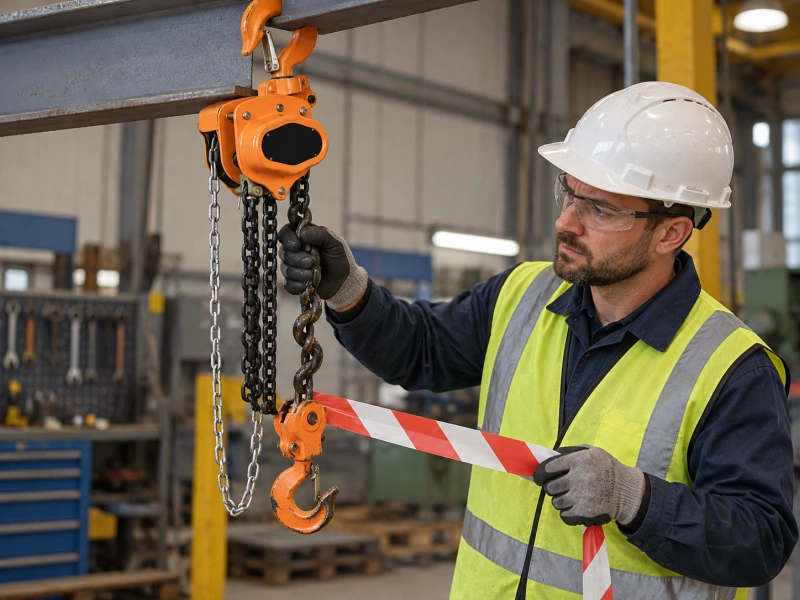
Do not improvise repairs. Remove the hoist from service, identify it clearly so it cannot be returned to service accidentally, and follow the manufacturer’s inspection, repair, and return-to-service process.
Common Manual Hoist Mistakes to Avoid
- Treating every manual hoist as suitable for the same load direction.
- Lifting an unknown load or exceeding the rated capacity.
- Side-loading hooks or operating with the load path out of line.
- Using the load chain as a sling, knotting it, or shortening it with unapproved hardware.
- Forcing a jammed chain or mechanism instead of stopping to investigate the cause.
- Extending a lever handle or using powered assistance to increase manual input.
- Installing an unapproved replacement chain, hook, fastener, or brake part.
- Standing beneath a suspended load or allowing people into the load path.
- Using an ordinary material hoist to lift people.
- Ignoring the effects of water, chemicals, temperature, dust, or other environmental conditions on the selected model.
Standards and Documentation
The applicable rules depend on the market, hoist design, installation, and jobsite. In North America, ASME B30.16 addresses overhead underhung and stationary hoists, including hand-chain-operated hoists used for vertical lifting and lowering of freely suspended loads.
ASME B30.21 covers lever hoists used for lifting, pulling, and tensioning applications within its scope. In Europe, EN 13157 covers hand-powered lifting equipment, including hand chain blocks and lever hoists.
A standards reference does not prove that every product or configuration complies with every market requirement. Confirm the exact model, current instructions, product markings, declarations or test documentation, inspection requirements, and destination-market requirements before use or purchase.
Choosing the Right Manual Hoist for the Job
If the job is controlled vertical lifting from a suitable overhead support, start with a hand chain hoist or chain block. If the task involves load positioning, pulling, or tensioning, a lever hoist may be appropriate when the exact model permits the intended application.
Compare the full manual hoist range by rated capacity, lift or reach, headroom, suspension or anchor arrangement, operating effort, service environment, and required documentation rather than choosing by capacity alone.
For an accurate quotation, send the total load, movement direction, required lift or reach, available headroom, suspension or anchor details, frequency of use, service environment, destination country, quantity, and required documents. You can also contact our lifting team with a drawing or clear site photographs when space or connection details may affect the selection.
FAQ
Can a Manual Hoist Be Used for Horizontal Pulling?
Do not assume that every manual hoist can pull horizontally. A standard hand chain hoist is normally selected for vertical lifting. Some lever hoists are designed for pulling or tensioning, but the exact model, anchor arrangement, and direction of force must be permitted by the manufacturer.
Do I Need to Inspect a Manual Hoist Before Every Use?
A pre-use visual and functional check is a prerequisite to operation. Formal inspection intervals and acceptance criteria should be based on the manufacturer’s instructions, the applicable standard, service conditions, and employer or site procedures. If damage or abnormal operation is found, remove the hoist from service.
What Should I Do If the Chain Jams or the Hoist Becomes Hard to Operate?
Stop applying force. Do not use extra people, a handle extension, a power tool, or another improvised method to force the mechanism. If it is safe to do so, secure or lower the load in accordance with the site contingency plan, remove the hoist from service, and have the cause assessed by qualified or authorized personnel.
Can I Lift More Than the Rated Capacity for a Short Time?
No. The rated capacity is an operating limit, not a target for occasional overload. Do not rely on a design factor, proof test, or breaking strength as permission to exceed the marked rated capacity.
Can a Manual Hoist Lift People?
Ordinary material-handling manual hoists should not be used to lift people. Personnel lifting requires equipment and procedures specifically designed and approved for that purpose under the applicable rules.
What Information Should I Give a Manual Hoist Supplier?
Provide the total load, required rated capacity, movement direction, lift or reach, available headroom, connection or suspension details, operator position, working environment, frequency of use, quantity, destination, and the documents your project requires. This is more reliable than asking for a hoist by tonnage alone.