A turnbuckle size is not one measurement. It normally combines the thread or nominal size, body length, take-up, open and closed overall length, end fitting dimensions, and the rated load of one exact product family. Measure these fields separately, then compare them with the manufacturer’s model-specific table.
If you are still comparing product families, begin with our range of turnbuckles. If you need a basic definition before reading the dimensions, see what is a turnbuckle. This page stays focused on size, measurement, and model-level capacity so those topics do not overlap.
How Turnbuckle Sizes Are Specified?
You should read a turnbuckle specification as a group of related dimensions, not as a single diameter. Two products may share the same nominal thread size and still have different bodies, adjustment ranges, end fittings, overall lengths, and working load ratings. The family name and end configuration are therefore part of the size description.
| Specification field | What it tells you |
| Thread or nominal size | The diameter and thread designation used by that product family. It may be shown in metric form, such as M12, or in inches, such as 1/2 in. |
| Body length | The length of the central frame or barrel as defined by the product drawing. It is not the same as the overall assembly length. |
| Closed length | The overall length at the minimum specified adjustment position. It is usually the first reference for replacement fit. |
| Open length | The overall length at the maximum intended adjustment position shown for that model. |
| Take-up | The usable adjustment range produced by threaded movement. Do not treat take-up as a synonym for open length. |
| End fitting dimensions | Eye inside diameter, jaw opening, pin diameter, hook geometry, swage dimensions, or other connection measurements. |
| WLL or SWL | The manufacturer-listed working load for the exact model and configuration, where a rated value is provided. |
Important: A drawing controls the measurement reference points. If a table uses symbols such as L1, L2, L3, B, E, or D2, match each symbol to the drawing supplied for that exact product before ordering.
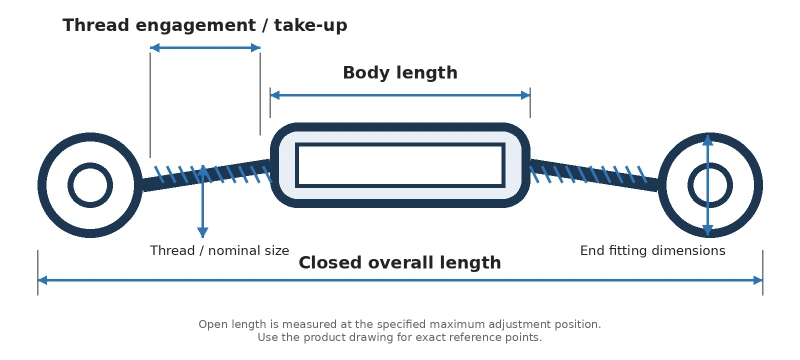
Turnbuckle Measurement Diagram
The diagram below shows the fields most buyers need to identify before comparing a turnbuckle size chart. It is a general measurement map, not a substitute for the drawing of a specific model.
How to Measure Turnbuckle Size for Replacement?
When replacing an existing unit, record every relevant dimension before you remove or discard it. Do not identify the replacement from the body length alone. A similar-looking body can use a different thread, end fitting, or adjustment range.
- Identify the product family and end configuration. Record whether the ends are eye-eye, hook-eye, hook-hook, jaw-jaw, jaw-eye, stub, swage, toggle, or another design.
- Clean the threads and read any markings. Record the marked model, nominal size, thread system, and load rating without estimating missing characters.
- Place the turnbuckle at the manufacturer-defined closed position. Do not force both threaded ends into contact or remove the required thread engagement.
- Measure the thread or nominal size. Use a caliper for diameter and confirm pitch or threads per inch with the appropriate gauge.
- Measure body length using the reference points shown in the product drawing. Then measure the closed overall length between the specified connection points.
- Measure the available take-up or adjustment range. If the original open position is unknown, do not infer it by extending the ends beyond the manufacturer’s specified engagement.
- Measure the connection geometry. Record eye openings, jaw width and pin diameter, hook opening, swage size, and any clearance that controls fit.
- Match the recorded dimensions and required rated load to one exact model. Confirm the complete assembly and connected hardware separately.
These steps identify a replacement; they are not installation instructions. For adjustment and installation procedure, use the separate guide on how to use a turnbuckle.
Thread Size, Body Length, Take-Up, Open Length and Closed Length
These terms are often mixed together, which is why a turnbuckle can be ordered incorrectly even when the nominal diameter appears right. Use the thread size to identify the threaded connection, the body length to identify the frame, and the overall lengths to check whether the assembly fits the available distance.
Take-up answers a different question: how much adjustment is available within the specified thread engagement. A longer body does not automatically prove a larger take-up, and a larger thread does not automatically prove a longer open length. Compare every field in the same family table.
Metric and imperial labels should also remain separate. M12 does not mean 1/2 in, even though the nominal diameters are close. Thread pitch and thread form may differ, so a near match can damage the threads or prevent full engagement. Use turnbuckle sizes in mm for metric products and turnbuckle sizes in inches for inch-series products; do not convert the label and assume interchangeability.
Turnbuckle Size Charts by Product Family
There is no single universal standard turnbuckle size chart that safely combines every construction and end configuration. The tables below stay separated by named product family. They are dimensional references for comparison; symbols must be read with the matching product drawing, and load values apply only where that family table expressly lists them.
Drop-Forged DIN 1480 Stub-End Turnbuckle Sizes
This metric table lists the website specification fields for the drop-forged DIN 1480 stub-end family. L1, L2, and L3 are family-specific drawing dimensions. The table does not publish a WLL, so you should not calculate or infer one from the thread size.
| Thread | L3 (mm) | L2 (mm) | L1 (mm) | Weight/100 pcs (kg) |
| M6 | 110 | 120 | 60 | 10 |
| M8 | 110 | 120 | 65 | 16 |
| M10 | 125 | 150 | 75 | 30 |
| M12 | 125 | 150 | 75 | 40 |
| M14 | 140 | 165 | 90 | 62 |
| M16 | 170 | 200 | 100 | 96 |
| M20 | 200 | 220 | 120 | 174 |
| M22 | 220 | 220 | 120 | 213 |
| M24 | 255 | 260 | 150 | 274 |
| M27 | 255 | 265 | 160 | 388 |
| M30 | 255 | 260 | 160 | 420 |
| M36 | 295 | 300 | 180 | 720 |
| M42 | 330 | 350 | 200 | 1070 |
| M48 | 355 | 380 | 220 | 1790 |
| M56 | 355 | 380 | 230 | 2000 |
Source: Drop Forged DIN1480 Turnbuckle Stub Ends product specifications
Stainless Steel DIN 1480 Turnbuckle Dimensions
The stainless DIN 1480 family uses different dimension symbols and a different size range. That difference is exactly why standard turnbuckle sizes should be compared family by family. Match LA, L2, b, da, C, and di to the drawing on the product page.
| Size | LA | L2 | b | da | C | di | Wt (kg) |
| M5 | 90 | 55 | 46 | 9.5 | 4.5 | 18.5 | 0.044 |
| M6 | 110 | 60 | 53 | 10 | 4.5 | 19 | 0.078 |
| M8 | 110 | 60 | 55 | 12 | 6.5 | 25 | 0.148 |
| M10 | 125 | 65 | 60 | 14 | 8 | 30 | 0.243 |
| M12 | 125 | 75 | 70 | 18 | 10.5 | 39 | 0.391 |
| M16 | 170 | 100 | 90 | 22 | 13 | 48 | 0.909 |
| M20 | 200 | 115 | 100 | 25 | 20 | 65 | 1.592 |
All dimensions are in mm unless shown otherwise. Source: DIN 1480 stainless steel turnbuckle specifications
U.S. Type Stainless Steel Eye-to-Eye Turnbuckle Sizes
This inch-series table belongs only to the U.S. type stainless steel eye-to-eye configuration. A repeated nominal size can have several body or take-up options, so include the complete row in an RFQ rather than sending only the first column.
| Size (in) | L (in) | L1 (in) | B (in) | E (in) | D2 (in) |
| 1/4 | 4 | 8 | 0.32 | 0.78 | 0.24 |
| 5/16 | 4.5 | 8.6 | 0.43 | 0.94 | 0.30 |
| 3/8 | 6 | 10.94 | 0.51 | 1.12 | 0.35 |
| 1/2 | 6 | 12 | 0.71 | 1.44 | 0.45 |
| 1/2 | 9 | 15 | 0.71 | 1.44 | 0.45 |
| 1/2 | 12 | 18 | 0.71 | 1.44 | 0.45 |
| 5/8 | 6 | 13.8 | 0.87 | 1.75 | 0.51 |
| 5/8 | 9 | 16.8 | 0.87 | 1.75 | 0.51 |
| 5/8 | 12 | 19.8 | 0.87 | 1.75 | 0.51 |
| 3/4 | 6 | 15.38 | 0.99 | 2.09 | 0.67 |
| 3/4 | 9 | 18.38 | 0.99 | 2.09 | 0.67 |
| 3/4 | 12 | 21.38 | 0.99 | 2.09 | 0.67 |
| 7/8 | 6 | 16.5 | 1.21 | 2.38 | 0.75 |
| 7/8 | 12 | 22.5 | 1.21 | 2.38 | 0.75 |
| 1 | 6 | 18.8 | 1.37 | 3 | 0.91 |
| 1 | 12 | 24.8 | 1.37 | 3 | 0.91 |
| 1-1/4 | 12 | 26.5 | 1.37 | 3.56 | 1.14 |
Source: US Type Stainless Steel Eye-to-Eye Turnbuckle specifications
Deck Lashing Turnbuckle Size and Rated Load Example
A load value can be published when it is tied to one named product and one exact row. The deck lashing family below is a useful example: its WLL is not a general rating for every 1-1/4 in turnbuckle.
| Size (in) | WLL (t) | Max. length (mm) | Min. length (mm) | Net wt. (kg/pc) |
| 1-1/4 x 18 | 25.50 | 1775 | 1270 | 16.80 |
Source: Deck Lashing Turnbuckle product specifications
How Turnbuckle Size Relates to WLL or SWL?
A turnbuckle load rating is model-specific. You cannot calculate WLL, SWL, or turnbuckle load capacity from nominal diameter alone because construction, material, manufacturing method, end configuration, thread engagement, and the manufacturer’s rating all affect the published value. Two 3/8 in turnbuckles can therefore have different ratings.
Searches such as “3/8 turnbuckle load rating” or “1/2 turnbuckle capacity” do not contain enough information for a safe answer. First identify the family and end configuration, then use the rating printed for that exact model. If the product table does not list a working load, request the controlled technical data from the supplier instead of substituting a generic internet chart.
Selection rule: Use the manufacturer-listed WLL or SWL for the exact model and follow the applicable engineering and assembly requirements. Do not apply a universal 25% margin, convert MBS into WLL with an assumed factor, or treat the weakest connected component as proof that every other component is correctly selected.
For available rated models and quotation support, review the turnbuckle product range and send the required load together with the dimensional fields listed below.
What Size Turnbuckle Do I Need?
Choose a size through a short sequence. Starting with a familiar diameter or an application label can lead you to the wrong product family. Start with connection geometry, then adjustment, then the exact rated model.
- Define the end connections. Confirm the required eye, hook, jaw, stub, swage, or toggle geometry and all pin, opening, and clearance dimensions.
- Define the installed length range. Record the required closed length, open length, and usable take-up at the manufacturer’s specified thread engagement.
- Confirm the load requirement. Select only from the exact family table or technical data that publishes the required WLL or SWL for that model.
- Confirm the thread system. Keep metric and inch-series threads separate, and verify pitch or threads per inch.
- Confirm material and finish for the service environment. Treat this as a separate product-selection decision, not as a reason to change dimensional definitions.
- Check the full assembly. Verify the connected hardware, alignment, clearances, installation method, and inspection requirements.
Use the turnbuckle types guide to compare end configurations. For material and finish choices, see turnbuckle material. Those pages own the broader type and material questions; this guide owns sizing and measurement.
Common Turnbuckle Sizing Mistakes
Measuring only the body. Body length does not identify the overall length, take-up, thread, or end fitting geometry.
Forcing the body fully closed. The specified closed position must preserve the required thread engagement. Physical contact is not always the correct reference.
Comparing unlike product families. A DIN stub-end table, stainless eye-to-eye table, and deck lashing table use different symbols and may publish different rated fields.
Assuming the same nominal size has the same capacity. A shared thread diameter does not create a universal WLL.
Mixing metric and inch threads. A close diameter is not proof of compatible pitch, form, or engagement.
Using a breaking-load chart as a working-load chart. MBS and WLL are different values. Publish or select only the rating provided for the exact model.
Sending an incomplete RFQ. A size label without end configuration, length range, connection dimensions, and required rating leaves critical choices unresolved.
Turnbuckle Size FAQ
How is turnbuckle size measured?
Measure the thread or nominal size, body length, closed overall length, open overall length or take-up, and the end fitting dimensions. Use the drawing for the exact product to identify the correct reference points.
Is body length the same as closed length?
No. Body length covers the central frame or barrel. Closed length covers the assembled turnbuckle at its defined minimum adjustment position.
What is turnbuckle take-up length?
Take-up is the specified usable adjustment range created by threaded movement. It is not automatically equal to body length or open length.
Are standard turnbuckle sizes universal?
No. Metric and inch-series products, body constructions, end configurations, and manufacturer families use different dimension sets. Compare a named family and its drawing.
Can I determine turnbuckle capacity from thread size?
No. Turnbuckle capacity or WLL must come from the manufacturer’s rating for the exact model and configuration.
What is the load rating of a 3/8 turnbuckle?
“3/8 turnbuckle” is incomplete. Identify the product family, end configuration, construction, and model, then check that exact table. Do not use a universal 3/8 in rating.
Can I replace an M12 turnbuckle with a 1/2 in model?
Do not assume they are interchangeable. Confirm thread form and pitch, body and overall lengths, take-up, end fittings, and the exact rated load.
What information should I send for a size quotation?
Send the product family or photo, end configuration, thread size and pitch, body length, closed and open length, take-up, end fitting dimensions, required WLL or SWL, material or finish, quantity, and the product drawing when available.
Need Help Selecting a Turnbuckle Size?
Send Powerful Machinery the required end configuration, thread system, body length, closed and open length, take-up, connection dimensions, required rated load, material or finish, and quantity. A marked drawing or clear photos help us compare the correct model without relying on a generic size chart.
Review available turnbuckles or contact Powerful Machinery for a quotation.