A turnbuckle is an adjustable mechanical fitting used to change the length or tension of a cable, wire rope, tie rod, or similar straight-line assembly. It has a central body and two threaded end fittings with opposite threads. Rotating the body draws both ends inward or moves them outward without disconnecting the assembly.
Key Takeaways
- A turnbuckle changes the effective length of a tensioned assembly so you can remove slack, set alignment, or adjust tension.
- Its main parts are a central body or barrel, one right-hand threaded end, one left-hand threaded end, and the connection fittings attached to those ends.
- Opposite threads allow both ends to move together when the body rotates; you do not need to rotate the connected cable or rod.
- Capacity, dimensions, connection details, thread engagement, and service conditions must be checked for the exact product rather than judged by appearance alone.
What Are the Main Parts of a Turnbuckle?
Most turnbuckles share the same mechanical layout even when their body shape, material, or end connections differ. Understanding the turnbuckle part names makes it easier to read a drawing, compare a specification, and see what moves during adjustment.
| Part | Function |
| Body or barrel | The central section you rotate. Its internal threads receive the two threaded ends. An open body exposes the threads; a closed body surrounds them. |
| Right-hand threaded end | Moves into or out of one side of the body as the body rotates. It uses a conventional right-hand thread. |
| Left-hand threaded end | Moves at the same time from the opposite side. Its left-hand thread is what makes simultaneous adjustment possible. |
| End fittings | Connect the turnbuckle to the cable, wire rope, rod, lug, shackle, or other compatible component. Common examples include eyes, hooks, and jaws. |
| Locking feature, when provided | Jam nuts, lock nuts, wire, clips, or another manufacturer-approved device can help secure the final adjustment against unwanted rotation. |
Two dimensions are especially useful when describing the assembly. Take-up is the usable adjustment distance between the more-open and more-closed positions. Thread engagement is the length of thread that remains safely engaged inside the body. Take-up is not the same as overall length, and neither value should be assumed from thread diameter alone.
The exact shape of each component varies by model. Some bodies are open for easy visual inspection, while others are closed for a slimmer, protected profile. Some assemblies include separate locking nuts; others use a different approved securing method. These details change how a product is specified, but they do not change the basic turnbuckle mechanism.
How Does a Turnbuckle Work?
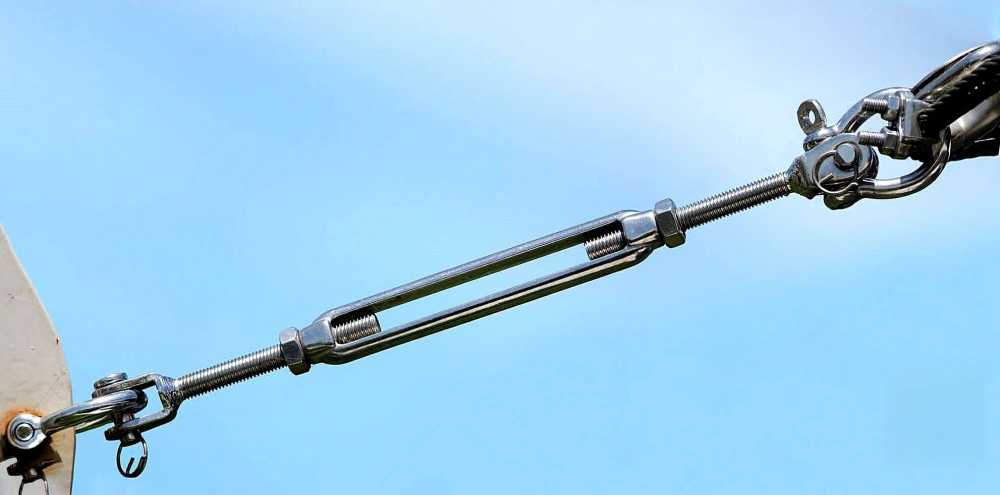
A turnbuckle converts rotation of the center body into linear movement at both ends. One internal thread is right-handed and the other is left-handed. Because the two threaded fittings advance in opposite rotational senses, turning the single body makes both ends travel inward together or outward together.
- The end fittings remain connected to the assembly while the central body is free to rotate.
- As the body turns, the right-hand and left-hand threads move both fittings by equal increments relative to the body.
- When the fittings move inward, the turnbuckle becomes shorter and tension generally rises. When they move outward, the turnbuckle becomes longer and tension generally falls.
This motion lets you make a controlled length correction without repeatedly disconnecting an end fitting. The change produced by each turn depends on the thread pitch and the geometry of the specific assembly. In practice, you monitor the position, alignment, or system tension while adjusting rather than relying on a fixed number of turns.
Do not use a universal rule such as “clockwise always tightens.” The apparent direction depends on which end you are viewing and how the turnbuckle is oriented. Watch the threaded ends: movement into the body shortens the assembly, while movement out of the body lengthens it. For connection, tightening, and securing procedures, follow the manufacturer’s instructions.
For practical installation steps, see how to use a turnbuckle.
Why Do Turnbuckles Use Opposite Threads?
If both threaded ends used the same thread direction, rotating the body would tend to advance one end while retracting the other. The assembly might shift position, but its effective length would not change in the balanced way required for tension adjustment.
Opposite threads solve that problem. A single rotation creates coordinated axial movement at both ends, so the overall length changes while the connections remain in place. This arrangement also centers the adjustment within the body and makes the remaining take-up easier to evaluate on an open-body design.
The two ends still need compatible thread forms, sizes, and engagement for the exact turnbuckle. A left-hand fitting is not interchangeable with a right-hand fitting merely because the nominal diameter appears the same.
Common Turnbuckle End Fittings: A Quick Overview
Turnbuckle names often describe the connection at each end. The three most common fitting styles are:
- Eye: a closed loop used with a compatible shackle, link, pin, or other connector.
- Hook: an open connection for applications where quick attachment is permitted and disengagement is controlled.
- Jaw: a clevis-style fitting with a pin for a positively retained connection to a compatible lug or eye.
Combinations include eye-and-eye, jaw-and-jaw, jaw-and-eye, hook-and-hook, and hook-and-eye. This is only a connection overview; compare the full types of turnbuckles before choosing an end configuration.
Where Are Turnbuckles Commonly Used?
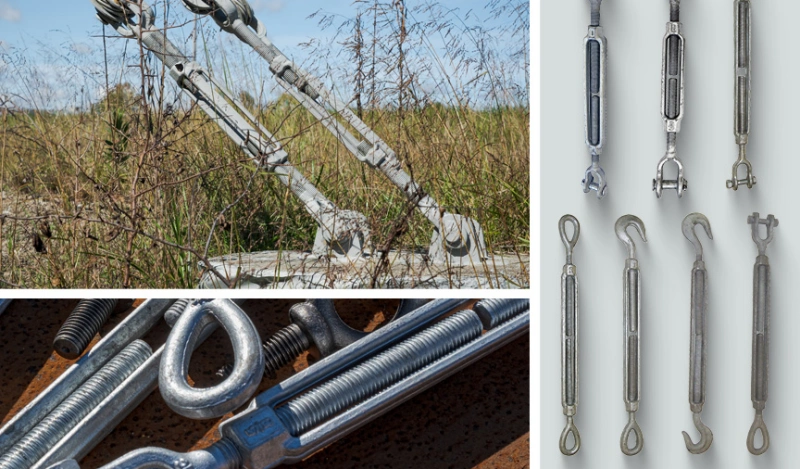
A turnbuckle is used where a straight-line assembly needs controlled tension or a limited length adjustment. Typical examples include guy wires and tie rods in construction, stays and cables in marine systems, and cable or rod alignment on industrial equipment.
The hardware must remain aligned with the direction of pull; it is not a hinge or a general-purpose side-load connector. See the dedicated guide to turnbuckle applications for a broader industry-by-industry discussion.
Turnbuckle Size and Capacity: What to Check
Turnbuckle size may refer to thread diameter, body length, take-up, closed length, open length, or end-fitting dimensions. Capacity is a separate rated value. A larger-looking body or a particular material does not by itself establish a working load limit.
Start with the required rated capacity and the exact connection geometry, then verify every dimension and the permitted operating range in the manufacturer’s data for that product family. Use the turnbuckle size guide when you need model-level dimensions and capacity information.
Basic Safety Notes
A turnbuckle is simple to adjust, but its safe use depends on the complete assembly. Apply the product manufacturer’s instructions and any requirements that govern the installation or lifting plan.
- Use only the rated values for the exact model and configuration; do not estimate capacity from diameter, finish, or appearance.
- Keep the pull in line with the turnbuckle and avoid side loading, shock loading, forced misalignment, heat, welding, or unauthorized modification.
- Maintain the required thread engagement at both ends and use the manufacturer-approved method to secure the final setting.
- Before use, check the body, threads, fittings, pins, keepers, markings, and locking features for damage, distortion, corrosion, wear, or missing parts.
Remove questionable hardware from service and have it evaluated under the applicable procedure. For detailed checks and rejection indicators, use the turnbuckle inspection guide. Not every turnbuckle is approved for overhead lifting; suitability must be confirmed for the exact product and application.
Need an Industrial Turnbuckle?
Powerful Machinery supplies industrial turnbuckles with common eye, hook, jaw, swage, toggle, open-body, and closed-body configurations. Product matching should be based on the required capacity, operating length, take-up, end connections, material or finish, and service environment.
Send your drawings or application details to request a quote. Include both connection points, the required adjustment range, rated load requirement, and operating conditions so the team can review the appropriate product family.
FAQ
What does a turnbuckle do?
A turnbuckle changes the effective length of a cable, wire rope, tie rod, or similar assembly. Shortening the assembly generally increases tension or removes slack; lengthening it generally reduces tension or adds adjustment room.
What are the three main parts of a turnbuckle?
The three main elements are the central body or barrel, a right-hand threaded end, and a left-hand threaded end. The threaded ends usually terminate in connection fittings such as eyes, hooks, jaws, studs, swages, or toggles.
Do turnbuckles have opposite threads?
A conventional turnbuckle uses a right-hand thread on one side and a left-hand thread on the other. This opposite-thread arrangement allows one rotation of the body to move both ends inward or outward at the same time.
How can a turnbuckle adjust tension without twisting the cable?
The end fittings stay connected while the body rotates around their threaded shanks. Because the two threads run in opposite directions, the fittings move axially relative to the body; the connected cable or rod does not need to rotate with it.
Does clockwise always tighten a turnbuckle?
No. The apparent direction changes with the viewing side and the orientation of the turnbuckle. Use the movement of the threaded ends as the reliable reference: inward movement shortens the assembly, and outward movement lengthens it.
Conclusion
The simplest turnbuckle definition is an adjustable fitting that changes the length and tension of a straight-line assembly. Its central body works with right-hand and left-hand threaded ends so both connections move together. Once you understand the parts, opposite-thread mechanism, take-up, and thread engagement, you can interpret the hardware correctly and move to the appropriate type, size, application, or installation guide without mixing those separate selection decisions into the definition itself.