Turnbuckle types are commonly classified in two ways: by the fittings at their ends and by the design of the center body. Eye, hook, and jaw combinations determine how the turnbuckle connects to an assembly, while open-body and closed-body designs determine how the threaded ends are enclosed and accessed.
Every type uses the same basic opposite-thread principle. If you need the definition, parts, and working mechanism first, read what is a turnbuckle. This guide stays focused on classification and the practical differences between configurations.
Key Takeaways
- End fittings are the main classification axis: eye, hook, and jaw ends can be paired in several combinations.
- Jaw is also called clevis in many product names; both terms describe a forked end that accepts a pin.
- Open and closed bodies form a second classification axis that affects thread visibility, access, and enclosure.
- Choose the connection type before checking size, rated capacity, material, finish, and operating environment for the exact model.
Turnbuckle Types by End Fitting
The end fitting determines what can connect to each side of the turnbuckle. A closed eye accepts a compatible connector, a jaw captures a lug or eye between two clevis arms with a pin, and a hook provides an open attachment. Product names combine the two ends, so an eye-and-eye turnbuckle has eyes at both ends and a jaw-and-eye turnbuckle has one of each.
No configuration is automatically best for every job. The correct type depends on the geometry of both connection points, how positively each connection must be retained, whether quick removal matters, and whether the complete assembly permits an open hook.
Eye & Eye Turnbuckles
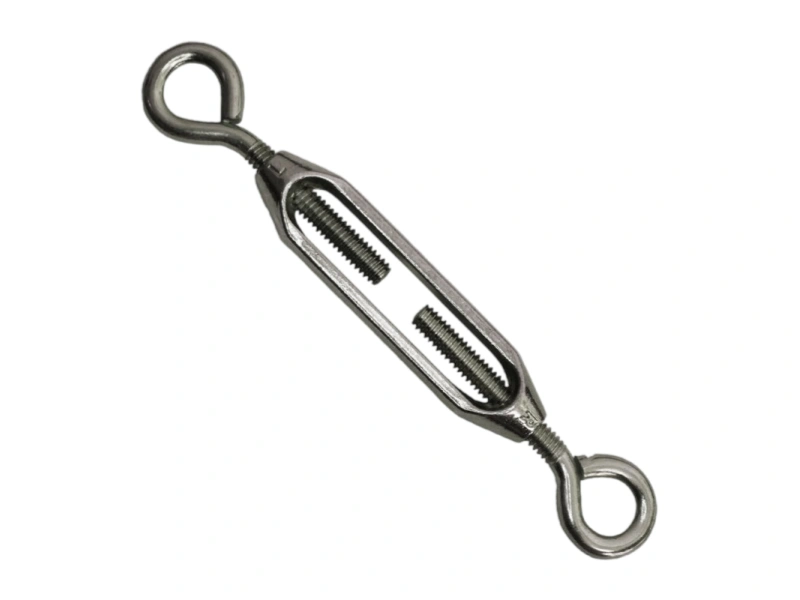
An eye and eye turnbuckle, also called an eye to eye turnbuckle, has a closed eye at both ends. Each eye normally connects through a compatible shackle, pin, link, or other connector rather than opening by itself. This configuration suits assemblies in which both connection points can accept separate connecting hardware.
The closed ends reduce the chance of an attachment simply slipping out when tension changes, but the eyes still need the correct inside dimensions, alignment, and connector fit. You must also account for the added length and articulation of any shackles or links used between the turnbuckle and the anchors.
Jaw & Jaw / Clevis Turnbuckles
A jaw and jaw turnbuckle has a forked jaw at each end. Each jaw fits around a compatible lug, plate, eye, or tab and is retained with a pin. Because the pin can be removed, the connection is both positively captured and serviceable when the components are correctly matched.
The term clevis turnbuckle commonly refers to this jaw-style connection. Check the jaw opening, inside width, pin diameter, side clearance, and keeper arrangement at both ends. A jaw does not correct misaligned anchors; the load path should still remain in line with the turnbuckle body.
Hook & Eye Turnbuckles
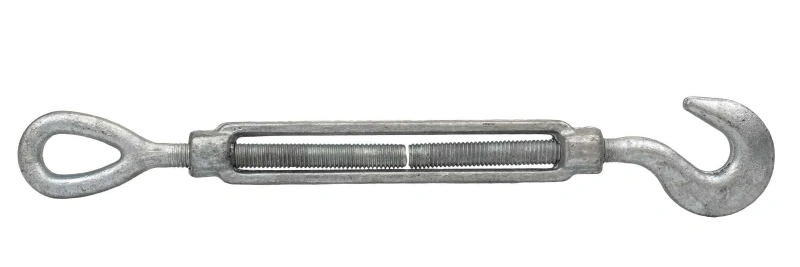
A hook and eye turnbuckle combines an open hook on one end with a closed eye on the other. The eye side accepts a compatible connector, while the hook side allows faster attachment or removal where an open connection is permitted. You may also see the same configuration described as a hook eye turnbuckle.
This mixed arrangement is useful only when the two anchor points genuinely require different connections. The hook must remain seated throughout the expected tension range, movement, and unloading condition. If loss of tension could allow disengagement, a retained eye or jaw connection may be more appropriate.
Hook & Hook Turnbuckles
A hook and hook turnbuckle uses an open hook at both ends. It is the quickest common configuration to attach and remove, but neither end is positively closed. That trade-off makes the surrounding geometry and the stability of tension especially important.
Use this type only where the design allows open hooks and both hooks remain properly seated during loading, unloading, vibration, or movement. Do not treat convenience as evidence that the configuration is suitable for a lifting or critical load-control application.
Jaw & Eye Turnbuckles
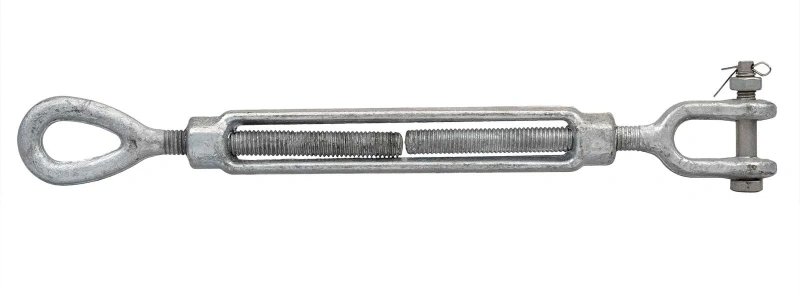
A jaw and eye turnbuckle combines a pinned clevis connection with a closed eye. The jaw can connect directly around a compatible lug or eye, while the opposite end connects through a shackle, link, pin, or other suitable component.
Choose this mixed type when one anchor is designed for a clevis pin and the other is designed for an eye connection. Verify the fit on each side independently; matching the jaw correctly does not confirm that the connector used through the eye is also compatible.
Other Catalogue-Backed End Configurations
Some assemblies use a more specialized termination instead of a second eye, hook, or jaw. A swage turnbuckle includes an end intended to be swaged to compatible wire rope or cable. A toggle turnbuckle uses a pivoting toggle-style end where limited articulation is required by the connection design. A stub-end turnbuckle uses a threaded or plain stud-style termination for a specific assembly layout.
These names describe connection geometry, not a universal rating or environment. Product construction, dimensions, material, finish, and permitted use vary by model, so specialized types should be matched to the actual termination method and product data.
Open-Body vs Closed-Body Turnbuckles
Body style is separate from end-fitting type. An eye-and-eye, jaw-and-jaw, or mixed-end turnbuckle may use an open or closed center body depending on the product design.
| Feature | Open-Body Turnbuckle | Closed-Body Turnbuckle |
| Construction | The center frame leaves the threaded ends visible. | The center body surrounds most or all of the engaged threads. |
| Inspection | Remaining engagement and movement are easier to observe directly. | Internal engagement is less visible and must be checked according to the product design. |
| Adjustment access | The open frame provides direct access around the body and threads. | The enclosed shape offers a compact exterior but may limit direct access to internal threads. |
| Exposure | Threads are more exposed to contact, dirt, and impact. | The body shields the threads from direct contact, but it does not make the assembly sealed or maintenance-free. |
| Selection question | Do you need visible engagement and frequent access? | Do you need an enclosed profile compatible with the installation and inspection method? |
Neither body style is universally stronger, safer, or more durable. Those properties depend on the exact product, material, manufacturing method, dimensions, rating, condition, and service environment. Select the body style according to access, inspection, clearance, and enclosure requirements, then verify the model-level specifications.
Turnbuckle Type Comparison Table
Use this table to compare connection logic, not to substitute for product specifications. The product links lead to examples in the current Powerful Machinery range; they do not mean that every size, material, finish, or rating is available in every configuration.
| Type | Connection method | Practical distinction | Product |
| Eye & Eye | Closed eyes at both ends; usually joined with compatible connectors | Both ends are closed, but separate pins, shackles, or links may be required | eye and eye turnbuckle |
| Jaw & Jaw / Clevis | Pinned clevis connection at both ends | Positive removable connection when jaw width and pin fit match | jaw and jaw turnbuckle |
| Hook & Eye | Open hook at one end; closed eye at the other | Combines quicker attachment on one side with a closed connection on the other | hook and eye turnbuckle |
| Hook & Hook | Open hook at both ends | Fast attachment, but both ends require control against disengagement | hook and hook turnbuckle |
| Jaw & Eye | Pinned jaw at one end; closed eye at the other | Matches two different anchor geometries in one assembly | jaw and eye turnbuckle |
| Swage | Swage-style cable termination combined with another end | Supports a cable termination designed for swaging | swage turnbuckle |
| Toggle | Pivoting toggle-style connection | Provides articulation only within the specific product geometry | toggle turnbuckle |
| Stub End | Stud-style termination combined with another end | Fits assemblies designed around a threaded or plain stub termination | stub-end turnbuckle |
The examples above show common type fit only. For a broader industry view, see turnbuckle applications.
How to Choose Between Turnbuckle Types?
Start with the two connection points. The correct turnbuckle type must match both anchors before material, finish, or nominal size becomes useful.
- Identify each anchor. Record whether it accepts a clevis pin, a connector through an eye, an open hook, a swaged cable terminal, a toggle, or a stud-style end.
- Decide how each connection must be retained. Use a jaw where a removable pinned clevis is required, an eye where a separate compatible connector is appropriate, and a hook only where an open connection is permitted.
- Choose the body style. Confirm whether visible thread engagement and access favor an open body or whether the installation needs a compatible enclosed profile.
- Verify the exact product. Check rated capacity, thread size, take-up, open and closed length, end dimensions, material or finish, thread engagement, locking method, and service conditions.
Do not turn type selection into a size estimate. Use the turnbuckle size guide for dimensions and rated-capacity checks, and the turnbuckle material guide when corrosion exposure and finish are the main questions.
Basic Safety Notes
- Use the rated values and instructions for the exact product; type names alone do not establish capacity or approval for lifting.
- Keep the turnbuckle aligned with the intended direction of pull and use compatible pins, connectors, keepers, and terminations.
- Maintain the required thread engagement and secure the final adjustment with the manufacturer-approved method.
- Check for damaged threads, distortion, wear, corrosion, missing parts, or illegible markings before use.
This article does not replace an installation procedure. Follow the separate guide on how to use a turnbuckle and use the turnbuckle inspection guide for more detailed condition checks.
FAQ
What are the main types of turnbuckles?
By end fitting, common types include eye and eye, jaw and jaw, hook and eye, hook and hook, and jaw and eye. Swage, toggle, and stub-end configurations serve more specialized connections. By body style, turnbuckles are generally open-body or closed-body designs.
Is a clevis turnbuckle the same as a jaw turnbuckle?
The terms are commonly used for the same forked, pin-connected end style. Product naming varies, so confirm the actual jaw opening, pin diameter, inside width, and keeper design instead of relying on the name alone.
What is the difference between an eye and a jaw turnbuckle end?
An eye is a closed loop that normally needs a compatible connector through it. A jaw surrounds a compatible lug or eye and secures it with a removable pin. The correct choice depends on the geometry and retention method at the anchor point.
What is the difference between open-body and closed-body turnbuckles?
An open-body turnbuckle leaves the engaged threads visible and accessible. A closed-body turnbuckle surrounds the threads with an enclosed center body. The difference affects visibility, access, clearance, and exposure, but it does not by itself establish strength or suitability.
When should you choose a hook and eye instead of a hook and hook?
Choose hook and eye only when one side needs an open hook and the other can use a closed eye connection. Hook and hook is appropriate only when open attachments are permitted at both ends and the hooks remain seated through the full operating condition.
Does material define the turnbuckle type?
No. Material and finish are selection factors, not the primary type taxonomy. The same end-fitting or body-style category may appear in different materials, but availability, rating, and corrosion performance must be verified for the exact model.
Explore Industrial Turnbuckles
Powerful Machinery supplies industrial turnbuckles across common eye, hook, jaw, swage, toggle, open-body, and closed-body configurations. Use the type guide to define the connection geometry, then confirm model-specific dimensions, capacity, material or finish, and operating requirements on the relevant product page.
For product matching, request a quote with drawings or measurements for both connection points, the required operating length and take-up, the rated load requirement, the service environment, and any material or finish preference.