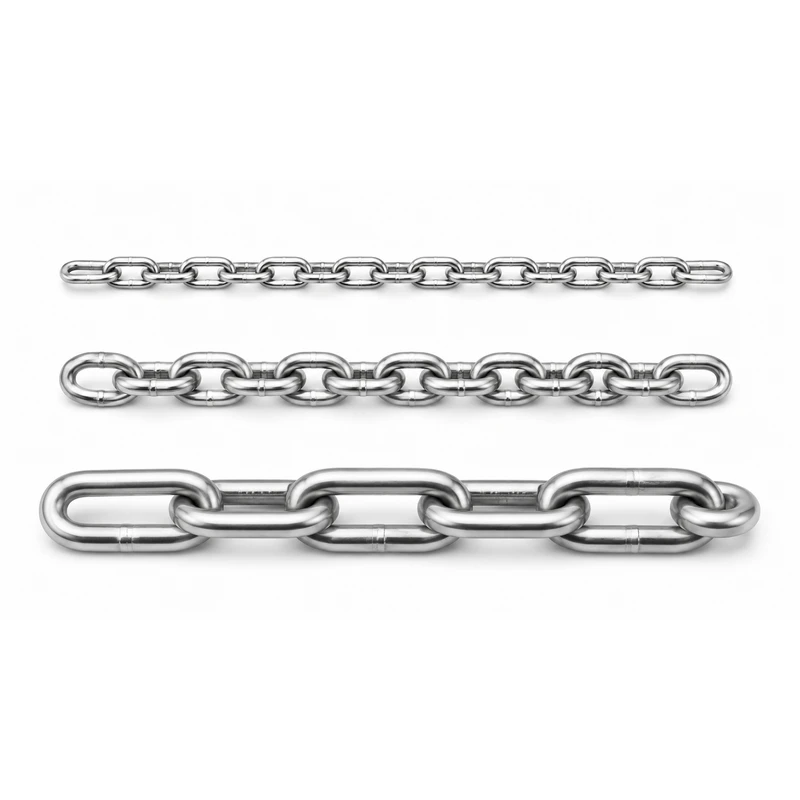
Rigging hardware is the detachable hardware used to connect, adjust, terminate, support, or redirect components within a load-handling or rigging assembly. In everyday jobsite language, “rigging gear” and “rigging equipment” may be used more broadly, which can blur the category boundaries. What rigging hardware means is explained in a separate definition guide.
This article focuses on the main hardware types, the function of each type, and the selection factors that distinguish them. If you already know which component you need, browse the rigging hardware product range.
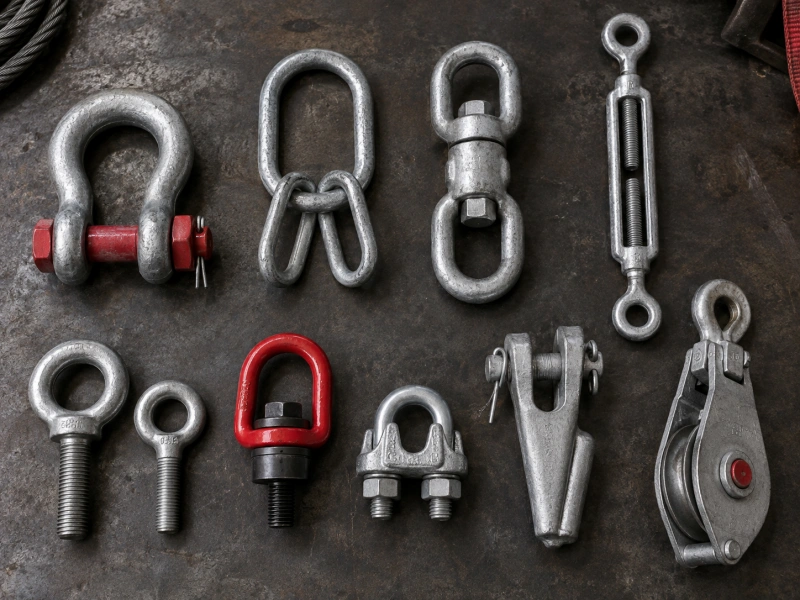
Quick Reference: Main Rigging Hardware Types
| Type | Main Function | Key Selection Factors |
| Shackles | Connect slings, links, wire rope eyes and lifting points | Body shape, pin type, WLL, connection clearance, load direction |
| Links and rings | Create connection points within sling or lifting assemblies | Link/ring shape, sling-leg compatibility, WLL, grade, connection geometry |
| Swivels | Allow controlled rotation where the product is designed and rated for it | Permitted loading direction, rotation under load, end connections, WLL |
| Turnbuckles | Adjust length or tension in rod, cable and wire rope systems | End fittings, thread size, body size, take-up, intended service, rating |
| Eye bolts | Provide a threaded fixed attachment or lifting point where specifically rated | Shoulder pattern/design, thread engagement, load direction, WLL |
| Hoist rings | Provide a rated lifting point that can pivot and/or swivel on compatible designs | Bolt/thread specification, seating, permitted loading angle, WLL by direction |
| Wire Rope Clips | Secure certain wire rope terminations when the design and instructions permit | Rope diameter/construction, clip type, number of clips, spacing, torque |
| Wedge sockets | Create detachable wire rope end terminations in compatible systems | Rope construction/diameter, socket compatibility, installation |
| Rigging blocks | Redirect rope and change line direction; some arrangements provide mechanical advantage | Sheave/rope compatibility, block rating, fleet angle, line forces |
Why “Rigging Hardware” and “Rigging Equipment” Are Not Always the Same Thing
ASME B30.26 defines a specific scope for detachable rigging hardware. It includes shackles, links, rings, swivels, turnbuckles, eyebolts, hoist rings, wire rope clips, wedge sockets, rigging blocks, and load-indicating devices. That scope is narrower than the way “rigging equipment” is often used in everyday industry language.
Other important rigging components are covered separately. Hooks are addressed by ASME B30.10. Slings made from chain, wire rope, metal mesh, fiber rope, or synthetic webbing are addressed by ASME B30.9. Lifting beams, spreader beams, and other below-the-hook lifting devices fall under ASME B30.20.
This distinction matters because similar-looking equipment can have different ratings, inspection rules, and intended uses.
1. Shackles
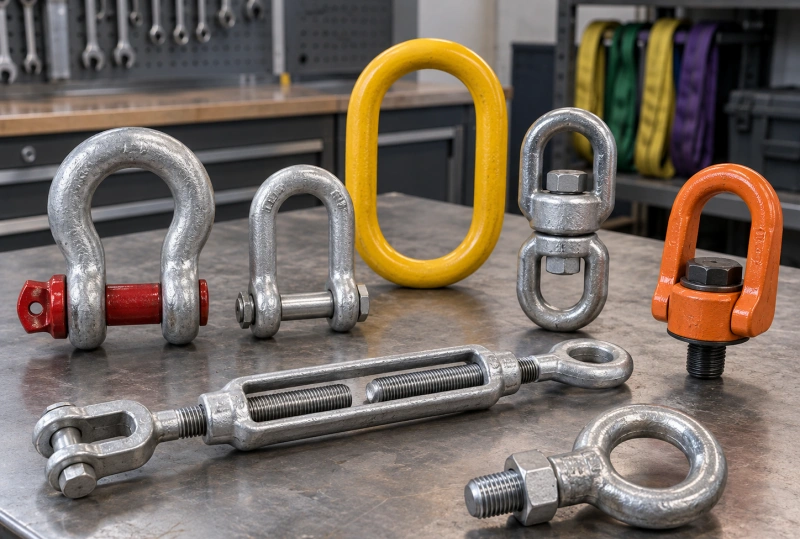
Shackles are detachable connectors used to join compatible sling eyes, links, wire rope terminations, lifting points, and other rated components. Common body styles include bow (anchor) and Dee (chain) configurations, while common closure arrangements include screw pins and bolt-type pins with retaining hardware.
A shackle is selected based on more than its nominal size: check the exact WLL, pin and bow dimensions, connection clearance, load direction, and manufacturer instructions. Browse shackles when you need the commercial product families and dimensions.
2. Links and Rings
Links and rings provide connection points in lifting and sling assemblies. Master links are a common example: they can serve as the upper connection between one or more sling legs and a crane hook or other compatible lifting point.
Selection depends on the assembly configuration, the number and angle of sling legs, WLL, grade, dimensions, and how the link seats in the mating component. See the current master links range for product-specific options.
3. Swivels
Swivels are used where controlled rotation is part of the connection design. Their purpose is not to make every assembly rotate freely under every load condition; permitted rotation, load direction, and rating depend on the exact swivel. Check the WLL, connection type, bearing or body design, permitted movement, and manufacturer instructions before using a swivel in a load path.
4. Turnbuckles and Rigging Screws
Turnbuckles adjust the effective length or tension of a rod, cable, or wire rope assembly by rotating a central body over threaded end fittings. Jaw, eye, hook, and swage end-fitting configurations are common.
A turnbuckle should not be treated as lifting-rated simply because it is used in a rigging system; confirm the exact product’s intended service, rating, thread size, body size, end fittings, and take-up. Compare turnbuckles by their actual product data rather than by end shape alone.
5. Eye Bolts
Eye bolts provide a threaded attachment point and, on products specifically designed and rated for lifting, can act as a fixed lifting point. Load direction is critical. Shoulder design, thread engagement, seating surface, material, WLL, and any angular-loading limits must come from the exact product data.
Do not assume that a general-purpose eye bolt is suitable for overhead lifting. The eye bolts and eye nuts category is the appropriate place to compare QDP product patterns.
6. Hoist Rings
Hoist rings are engineered lifting points that can pivot, swivel, or both on designs intended for angular loading. That movement does not mean the rated capacity remains unchanged at every angle. Rated capacity, installation torque, bolt/thread engagement, seating, and permitted loading direction are model-specific. Use the manufacturer’s rating chart and installation instructions for the exact hoist ring.
7. Wire Rope Clips
Wire Rope Clips are used in certain wire rope terminations and securing arrangements. Correct installation depends on the clip design, rope diameter and construction, number of clips, spacing, orientation, torque, and retorque requirements. These requirements are product- and rope-specific. If your assembly uses clips, thimbles, sleeves, or sockets, start with the wire rope fittings category and then follow the exact fitting manufacturer’s instructions.
8. Wedge Sockets
Wedge sockets are detachable end terminations used with compatible wire rope in many hoisting and crane systems. The rope diameter and construction, socket size, live-end/dead-end arrangement, and installation method must match the manufacturer’s specification. A visually similar socket is not automatically interchangeable with another design.
9. Rigging Blocks
Rigging blocks guide or redirect rope and can be arranged to change line direction or mechanical advantage. Selection depends on rope diameter and construction, sheave size, block rating, line pull, fleet angle, attachment method, and the forces created by the reeving geometry. See rigging blocks for the relevant QDP product family, provided the final live URL remains the site’s chosen commercial category.
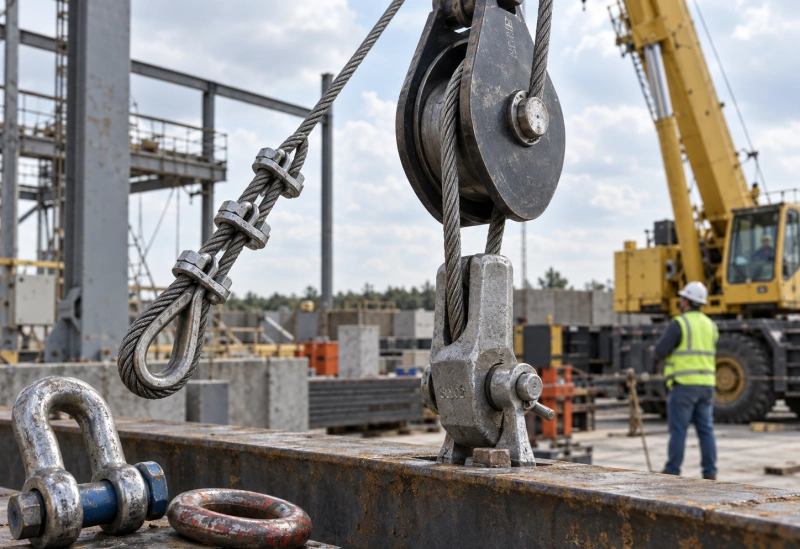
Where Do Hooks, Slings, Chain, and Wire Rope Fit?
They are part of the wider rigging system, but it is useful to separate them from the narrower B30.26 hardware category. Lifting hooks are commonly called rigging hardware in trade language, yet ASME addresses hooks in B30.10. Slings are addressed separately in B30.9. Chain and wire rope can be load-bearing media or sling components, depending on the assembly.
Lifting beams and spreader beams are below-the-hook lifting devices rather than detachable rigging hardware.
How to Choose Between Rigging Hardware Types?
- Start with the function. Decide whether the component must connect, tension, provide a lifting point, terminate wire rope, rotate, or redirect a line.
- Verify the rated capacity for the actual configuration. Use the exact product WLL or rated load for that configuration, and account for the permitted load direction, sling angle, dynamic effects, and any manufacturer-specified reductions.
- Check the complete connection. Pin diameter, hook throat, sling eye width, thread form, wire rope diameter, clearances, and mating-component geometry all matter.
- Match the material and finish to the environment. Corrosion resistance, temperature, chemicals, and coating condition matter, but material alone does not establish a lifting rating.
- Confirm the product pattern, applicable standard, and markings required by the job. Similar shapes made for lifting, lashing, towing, marine, or architectural service are not automatically interchangeable.
- Inspect and maintain the component under the correct rules for its service. For detailed inspection tasks, use the dedicated rigging hardware inspection guide rather than generic rejection limits copied from another product family.
If the question concerns straight-line or vertical loading, use the focused guide to hardware for vertical pulls so that the applicable loading limits are not reduced to a one-line rule on this page.
For inspection frequency, removal criteria, and recordkeeping, continue with the rigging hardware inspection guide. Requirements vary with the hardware type, service, manufacturer instructions, applicable standard, and jurisdiction.
Material and Finish Are Selection Factors, Not Hardware Types
Carbon steel, alloy steel, galvanized finishes, and stainless steel describe material or corrosion-protection choices rather than separate functional hardware types. The same general function—such as a shackle or turnbuckle—can appear in different materials and finishes. Choose the material after the function, rating, and connection geometry are known.
Where corrosion resistance is the main procurement driver, compare the dedicated stainless steel rigging hardware collection rather than treating stainless steel as a universal substitute for load-rated carbon or alloy products.
FAQ
What Are the Most Common Types of Rigging Hardware?
Common detachable types include shackles, links and rings, swivels, turnbuckles, eye bolts, hoist rings, wire rope clips, wedge sockets, and rigging blocks. ASME B30.26 also includes load-indicating devices within its scope.
Are Slings Considered Rigging Hardware?
In casual jobsite language, slings may be grouped under “rigging gear” or “rigging equipment.” In the ASME B30 structure, slings are treated separately under B30.9 rather than as B30.26 detachable rigging hardware.
Are Hooks Rigging Hardware?
Hooks are often described as rigging hardware commercially, but ASME covers hooks separately in B30.10. A technical types guide should therefore distinguish trade terminology from standards-based classification.
What Is the Difference Between a Shackle and a Master Link?
A shackle is a detachable connector with a body and a removable pin or bolt assembly. A master link is a closed link or ring commonly used as the top connection in a sling assembly. The correct choice depends on how the assembly connects, the required rating, and the mating geometry.
Does Stainless Steel Make Rigging Hardware Safer?
No. Stainless steel can improve corrosion resistance in suitable environments, but safety depends on the exact product design, rating, markings, installation, load direction, compatibility, inspection, and manufacturer instructions.
Conclusion
A practical way to understand rigging hardware is by function: connectors such as shackles and links; adjusters such as turnbuckles; lifting points such as eye bolts and hoist rings; wire rope termination hardware such as clips and wedge sockets; rotating hardware such as swivels; and rope-control hardware such as rigging blocks.
Once the function is clear, selection moves to rating, load direction, connection geometry, environment, and the exact product documentation.
When you are ready to move from learning to product selection, use the rigging hardware product range to compare the available commercial families.