Choosing a lever hoist manufacturer is an evidence-based procurement task. Start with the load, required movement, workspace, and destination market. Then compare manufacturers using model-specific data and documents that match those requirements. A familiar brand name, a long list of certifications, or a low unit price does not establish that a hoist is suitable for the application.
This guide explains what to request from a manufacturer or supplier, how to compare quotations on a like-for-like basis, and which claims require verification before purchase.
Last reviewed: 11 September 2026. Evaluation basis: published model information, current supplier documents, and evidence requested during the quotation process. This is a procurement guide, not a ranking of manufacturers.
Manufacturer, Supplier, and Brand Owner Roles
The terms manufacturer and supplier are often used interchangeably, but their commercial and legal roles can differ. The legal manufacturer may control product design and production records. A brand owner may source some or all production from another factory. An authorized distributor may provide local stock, service, and warranty support. A rental or service company may own equipment without manufacturing it.
Ask the seller to identify its role for the exact model. If the seller is not the legal manufacturer, confirm who issues the declaration, test documentation, operating instructions, and warranty. Also confirm who can approve changes, supply approved spare parts, and assess equipment returned for repair.
Define the Application Before Comparing Manufacturers
A useful comparison starts with a written application brief. State the maximum load, including rigging and below-the-hook equipment, and describe whether the task involves lifting, pulling, tensioning, or positioning. Record the required lift or reach, available headroom, suspension or anchor arrangement, operator position, handle clearance, operating frequency, and environment.
If the equipment type has not been decided, review what a lever hoist is and how it works and compare a lever hoist with a chain block before requesting prices.
Compare Exact Models Using Published Data
Do not compare a manufacturer’s range headline with a competitor’s individual model. Put the exact model numbers in one table and use consistent units. Ask the supplier to identify the document revision and confirm that the quoted product matches the published data.
| Field to Compare | Why It Matters | Evidence to Request |
| Rated capacity | Must cover the complete load for the approved task | Nameplate, current data sheet, and quoted model number |
| Lift or reach | Determines available travel and required chain length | Standard value, optional lengths, and added chain weight |
| Operating effort | Affects practical manual operation at rated load | Published operating force and handle length |
| Headroom and dimensions | Confirms hook-to-hook headroom and handle clearance | Dimensioned drawing for the quoted model |
| Load chain | Must match the hoist design and load sheave | Number of falls, chain diameter and specification, and replacement part number |
| Net and shipping weight | Affects handling, transport, and total landed cost | Net weight, packing dimensions, and gross weight |
| Permitted task and environment | Prevents use outside the model’s approved design | Instructions, temperature range, and environmental restrictions |
| Options | May change dimensions, documentation, or lead time | Approved option list and revised drawing, where required |
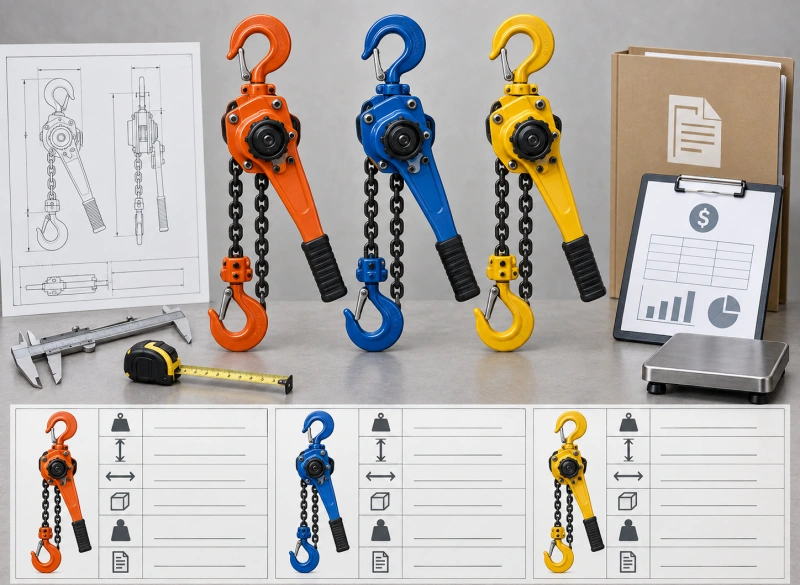
Rated capacity is not a measure of productivity. A higher-capacity hoist may be heavier or require greater operating force. Select the capacity required by the load assessment and governing procedure, then compare only models that satisfy the application.
Check Testing and Compliance Documents
Ask which standard and edition apply to the quoted model and destination market. ASME B30.21 addresses lever-chain, rope, and web-strap hoists used for lifting, pulling, and tensioning. EN 13157 covers hand-powered lifting equipment, including lever hoists. A reference to either standard does not prove that every model complies.
Request the documents required for the destination market and project. These may include the manufacturer’s declaration, model data sheet, operating instructions, test record, serial or batch identification, inspection record, and a third-party certificate when the contract requires one. Check that the company name, model, rated capacity, standard edition, and dates agree across the documents.
Treat ISO 9001 separately. It can support an assessment of the manufacturer’s quality management system, but it is not a lever-hoist product approval. Likewise, a CE mark or another market mark must be supported by the applicable declaration and technical basis for that product and market.
Review Quality Control and Traceability
Ask the manufacturer to explain how it controls safety-related components and finished assemblies. The response should identify actual records rather than rely on general phrases such as rigorous testing or advanced quality control.
- Incoming verification of load chain, hooks, gears, shafts, brake components, and fasteners.
- Controls for heat treatment, dimensions, chain calibration, and component identification, where applicable.
- Assembly checks covering chain travel, selector operation, brake function, hook rotation, latches, and markings.
- The production test method, acceptance criteria, and records linked to the serial number or production batch.
- Control of nonconforming product, corrective actions, and document revision.
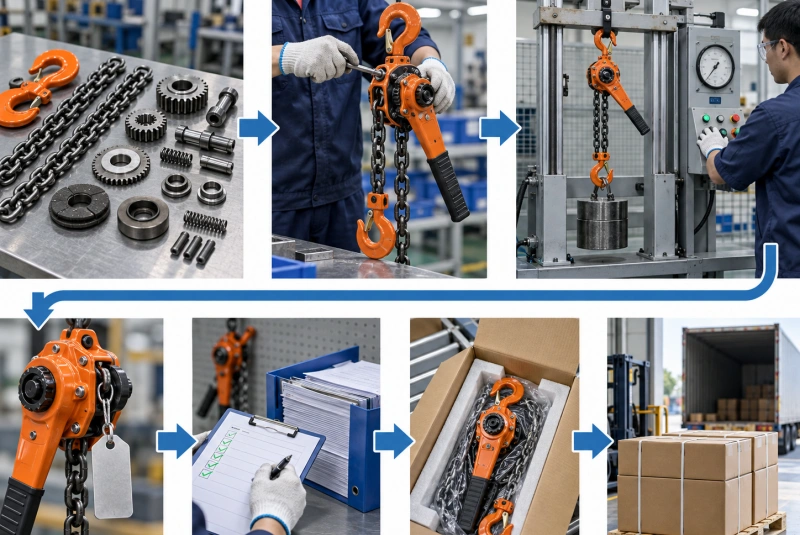
A factory audit can confirm whether written procedures match production practice. For a remote review, request dated photographs or videos of the relevant production line, sample records with confidential information redacted, and a clear explanation of which operations are performed in-house.
Confirm Spare Parts and Service Support
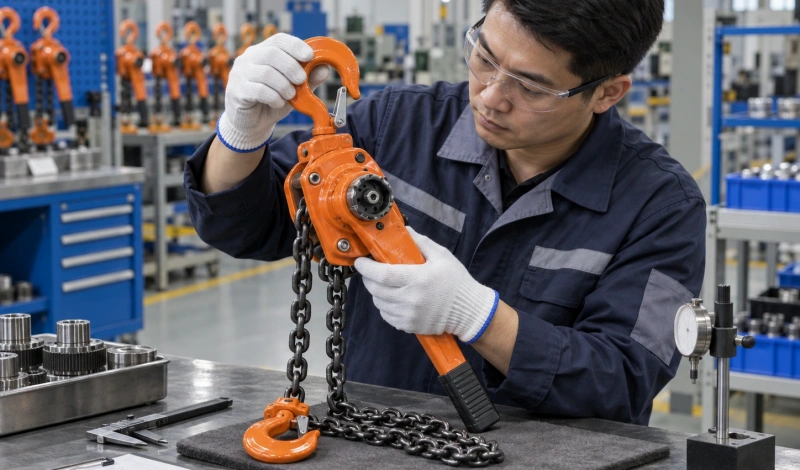
A lever hoist remains serviceable only when the correct parts, instructions, and repair decisions are available. Ask for an illustrated parts list, current manual, spare-parts lead times, warranty process, and the location of authorized service support. Confirm whether hooks, latches, brake components, and load chain are supplied as approved, model-specific replacement parts.
Build the receiving and maintenance plan around the manufacturer’s instructions and a documented inspection program. The lever hoist inspection checklist can help organize the review, but the exact discard criteria must come from the applicable instructions and rules.
Evaluate OEM and Customization Requests
OEM work may include color, brand markings, packaging, manual language, lift length, or approved accessories. Ask which changes are cosmetic and which affect the product configuration. Any change that affects load-bearing parts, dimensions, braking, load chain, hooks, or intended use requires engineering review and updated documentation.
Before approving a private-label order, agree on the legal manufacturer’s name, model coding, nameplate content, document owner, change-control process, inspection plan, and sample-approval process. Do not remove required warnings or substitute general-purpose chain to meet branding or cost targets.
Compare Delivery and Total Landed Cost
Compare quotations line by line. Include the hoist, required lift, options, spare-parts kit, manuals, test documents, inspection fees, packaging, tooling, freight, duties, and local delivery. Record the production lead time and the event it starts from. Distinguish a confirmed delivery commitment from an estimate.
Warranty duration alone is not enough. Review the exclusions, claim procedure, return freight, labor coverage, and decision time. A distributor with local parts may reduce downtime even when its unit price is higher. Direct purchase from a manufacturer may suit larger or customized orders, but that advantage must be confirmed in the quotation.
Manufacturer Comparison Scorecard
Use the same scoring method for every shortlisted vendor and retain the supporting evidence behind each score. Adjust the weights before requesting quotations if the project has different priorities.
| Evaluation Area | Suggested Weight | Minimum Evidence |
| Application and model fit | 25 | Completed technical schedule, current data sheet and drawing |
| Compliance and test documents | 25 | Applicable declaration, instructions and traceable test evidence |
| Quality control and traceability | 20 | Process description, sample records and corrective-action route |
| Parts, Warranty, and Service | 15 | Parts list, lead times, warranty terms and service contact |
| Delivery and commercial terms | 15 | Complete quotation, confirmed lead time and Incoterms |
A failed mandatory requirement should not be masked by a high total score. Treat rated capacity, permitted application, required documents, and destination-market compliance as pass/fail conditions before comparing price.
Working With Powerful Machinery
Powerful Machinery manufactures and supplies manual lever hoists. The current Powerful Machinery lever hoist range lists VA and VL series models from 0.75 to 9 t, with a 1.5 m standard lift across the listed models.
For model-specific capacity, lift, operating effort, load-chain falls, dimensions, and weight data, review the VA Series lever hoist specifications. Additional compact options include the HSH AL lever chain hoist. Confirm the current specification, required lift, documents, options, and production schedule in the quotation.
For a wider category review, compare our manual hoists by operating method. You can also review company and manufacturing information before supplier qualification.
Lever Hoist Quotation Checklist
Send the same information to every shortlisted manufacturer so that the quotations remain comparable:
- Maximum load, including rigging and attachments, plus the required movement and load path.
- Required rated capacity, lift or reach, headroom, hook openings, handle clearance, and operator position.
- Use frequency, indoor or outdoor conditions, temperature, moisture, dust, corrosion, and any hazardous-area restrictions.
- Destination country, required standard or declaration, test documents, manual language, and marking requirements.
- Quantity, delivery location, Incoterms, target date, packaging, and spare-parts requirements.
- OEM branding or approved configuration changes, including sample and document approval stages.
Send your requirements to our technical sales team and request a model-specific quotation.
FAQ
How Do I Verify a Lever Hoist Manufacturer?
Verify the company’s role, exact model data, applicable standards, test and traceability records, quality-control processes, spare-parts support, warranty route, and service contact. Use the same evidence checklist for every vendor.
Is a Manufacturer Always Better Than a Distributor?
No. A manufacturer may support customization and larger orders, while an authorized distributor may provide local stock, service, and spare parts. Choose the route that best meets the technical, documentation, delivery, and support requirements.
Which Lever Hoist Certification Should I Request?
There is no single certificate for every market and application. State the destination and project requirements, then request the declaration, test evidence, and instructions that apply to the quoted model and standard edition.
Can a Lever Hoist Manufacturer Customize the Product?
Some manufacturers offer approved changes to color, marking, packaging, lift length, or accessories. Confirm whether each change affects the product configuration, and require updated drawings, markings, and documents when it does.
How Should I Compare Lever Hoist Prices?
Compare the same rated capacity, lift, options, documents, packaging, and delivery terms. Include freight, duties, spare parts, inspection fees, warranty handling, and expected downtime rather than comparing unit price alone.
Should I Add 25 Percent to the Required Capacity?
Do not use a blanket 25 percent rule. Determine the complete load, follow the lift plan and governing requirements, and select a model whose rated capacity and permitted application meet those conditions.