/
/
4 Leg Chain Sling​

4 Leg Chain Sling​

Our 4-leg chain sling is built for heavy lifting, using grade 100 alloy for maximum strength. With customizable fittings, size, and length, it offers reliability and safety for industries that require top performance. Perfect for businesses that need durable, high-capacity lifting solutions.
4 leg lifting chain sling​

As a trusted manufacturer of 4 leg chain slings, we specialize in custom lifting solutions, from small-scale to heavy-duty applications. We focus on providing high-quality chains with strength-enhancing features, such as triple alloy (nickel, chromium, molybdenum), and single-weld links for greater durability and safety.

When placing an order for a custom 4 way chain sling, please keep these details in mind:

  1. SIZE: This depends on the material size of the chain, which is determined by the working load limit you need.

  2. REACH: Measured from bearing point to bearing point, including all attachments.

  3. ATTACHMENTS: Standard master links are used unless specified otherwise. If you require custom master links or hooks, please provide a description or drawing.

  4. TYPE: Select the appropriate sling type, such as:

    • T = Four Leg

    • O = Oblong Link

    • S = Sling Hook (if needed)

By providing these details, we ensure your 4 chain lifting sling is designed to meet your specific lifting needs, offering the strength, safety, and reliability you expect.
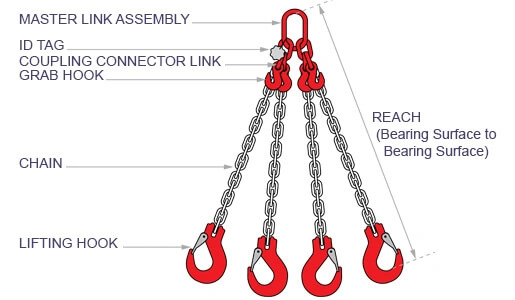
4 leg chain lifting sling

4 leg chain sling​

DESIGN

GRADE

FINISH
STANDARDS
HEAT TREATMENT
ORIGIN
LINK TYPE
APPLICATION
MATERIAL

FAQ OF FOUR LEG CHAIN SLING

What is a 4 leg chain sling and when do you use it?

A 4 leg chain sling gives you four adjustable load paths from one master link. You gain load balance, control, and redundancy for complex lifts. Our customers choose this sling for oversized steel structures, machinery frames, prefast concrete, turbines, ship blocks, and mining equipment. You shorten setup time because four legs stabilize the load without extra rigging. You reduce lift rotation and edge stress.

4 leg chain sling weight depends on chain diameter, leg length, hook type, and master link size. A 10mm Grade 80 sling weighs far less than a 16mm Grade 100 sling with clevis grab hooks. Weight affects crane capacity, rigging speed, transport cost, and worker fatigue. Smart buyers calculate sling self-weight before lift planning.

4 leg chain sling calculation requires sling angle, chain grade, and load symmetry. You never assume all four legs share equal load. Industry standards rate most 4 leg slings at 2-leg capacity unless geometry guarantees equal loading. We calculate using trigonometric load factors tied to the lowest sling angle.
Calculation essentials buyers must follow:
• Measure the smallest leg angle under load
• Apply angle factor to single-leg WLL
• Treat unequal loads as two-leg lifts
• Avoid angles below 45 degrees
• Document calculations for audits

4 leg chain sling price changes based on material grade, chain diameter, leg length, hooks, certifications, and volume. Factory-direct pricing saves buyers margin loss from distributors. A small Grade 80 sling costs far less than a long-leg Grade 100 offshore-rated assembly.

Load physics rarely distribute force evenly across four legs. Minor length differences or shifting centers force two legs to carry most load. Manufacturers rate conservatively to protect crews and equipment. We design leg tolerances tightly but never promise equal load share unless engineered lifting points exist.

Grade 100 chain delivers higher strength with smaller diameter compared to Grade 80. You lift more while reducing sling weight. Energy, mining, and shipyard buyers prefer Grade 100 for confined spaces and long reaches. Grade 80 still suits general construction and rental fleets.

Service life depends on usage intensity, environment, inspection discipline, and overload history. Properly maintained slings last many years. Harsh conditions like saltwater, heat, or abrasive dust shorten life. We design slings for inspection access and component replacement.
Longevity strategies buyers adopt:
• Rotate slings across jobs
• Replace hooks before chain wear peaks
• Store off-ground and dry
• Track lift cycles digitally
• Reject overloaded assemblies immediately

You inspect visually before every lift. You check chain elongation, cracks, gouges, hook throat opening, latch function, and tag readability. You stop use when defects appear. We stamp clear rejection criteria on tags to speed decisions.
Pre-lift inspection checklist:
• Chain link deformation
• Excessive corrosion
• Hook twist or spread
• Missing safety latches
• Illegible ID tags

Yes. We build custom 4 leg chain slings for project-specific geometry, extreme loads, offshore rules, and government tenders. Customization improves safety and efficiency while reducing rigging improvisation onsite.

Related Products

Get in touch
Download Product Catalog

After downloading the product catalogue, our dedicated technical experts will provide you with one-on-one service.