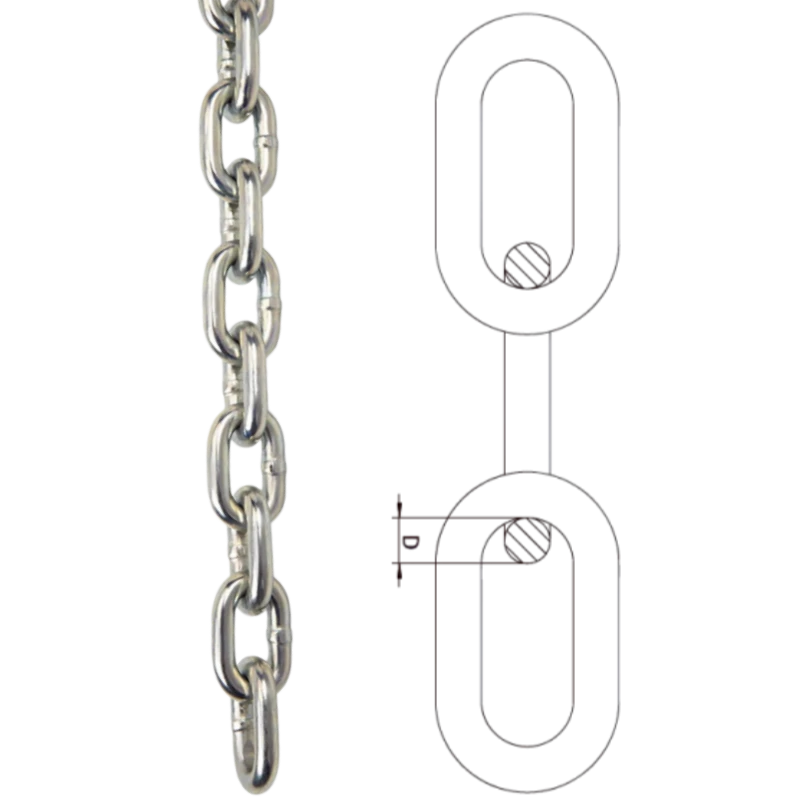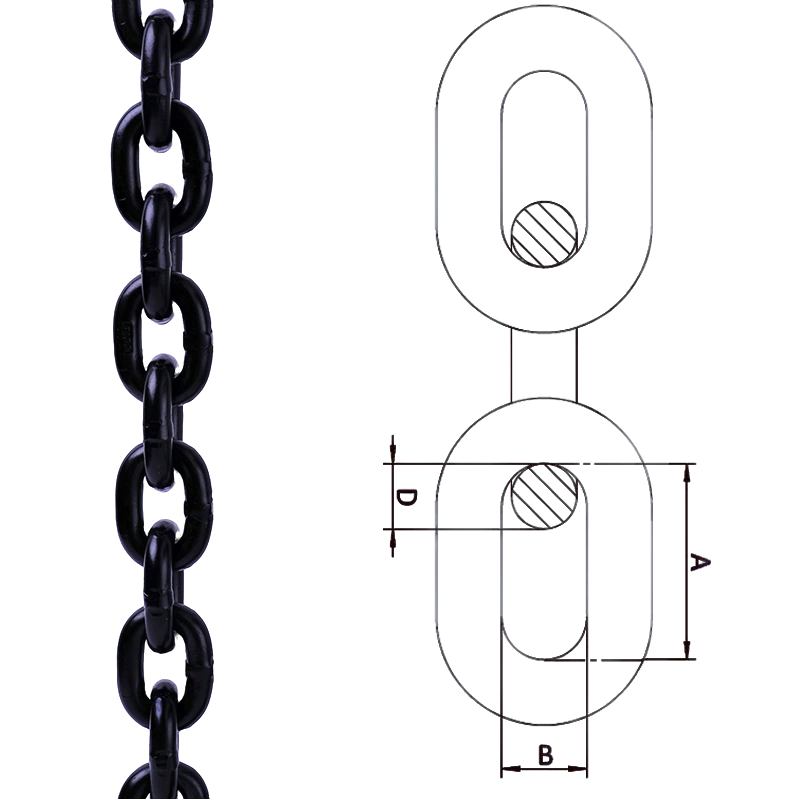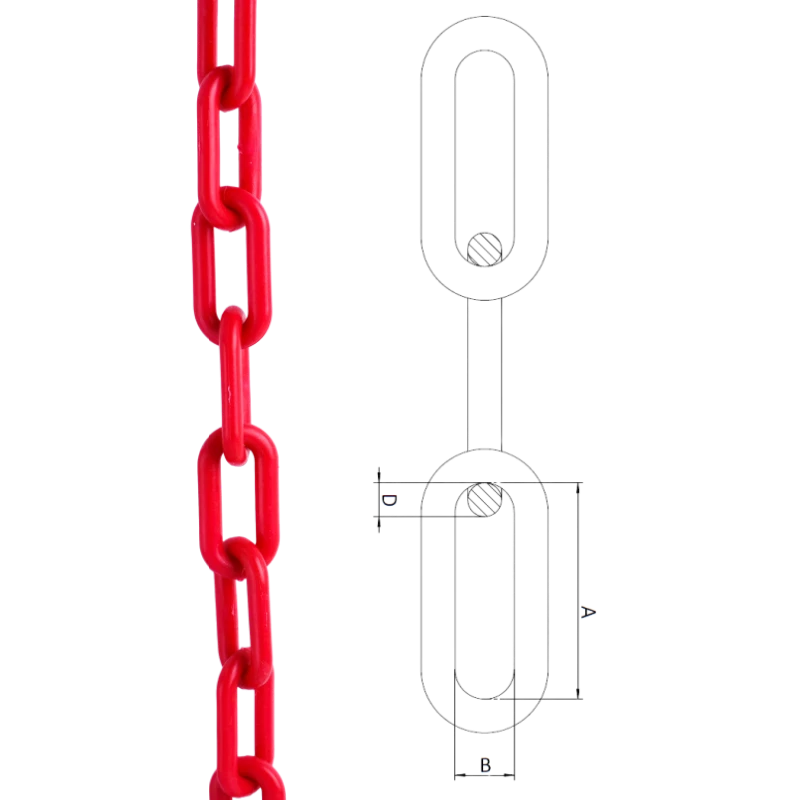
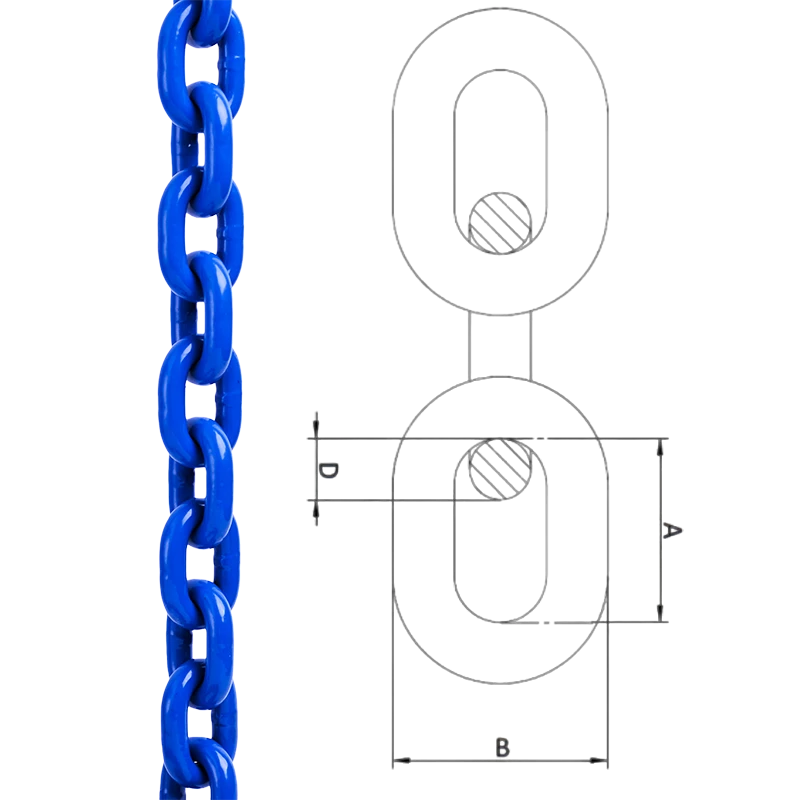
DIAGRAMS of Grade 100 Alloy Chain
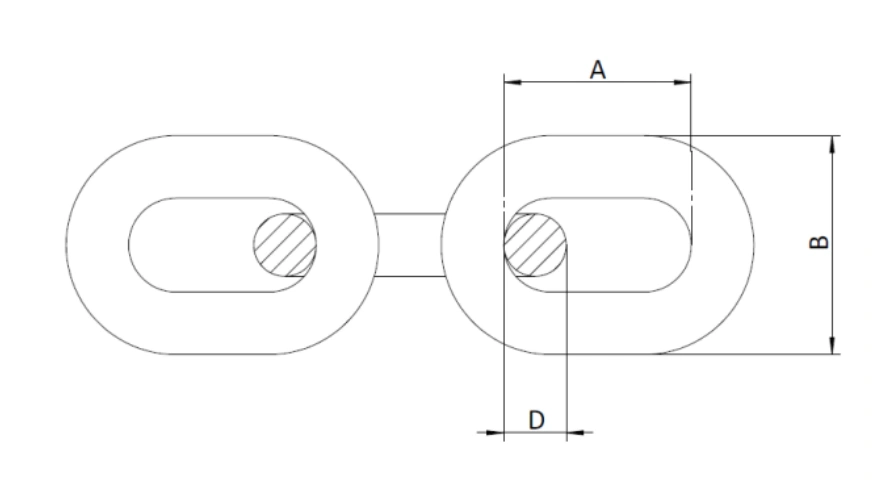
GRADE 100 CHAIN SPECS
| Size mm |
Pitch mm |
Deviation Max |
Deviation Min |
Inside Width mm |
Outside Width mm |
Weight Kg/m |
Working Load Kn |
Proof Load Kn |
Break Load Kn |
| 8 | 24.00 | 24.70 | 23.30 | 10.40 | 29.60 | 1.40 | 25 | 62 | 100 |
| 10 | 30.00 | 30.90 | 29.10 | 13.00 | 37.00 | 2.20 | 39 | 98 | 157 |
| 13 | 39.00 | 40.20 | 37.80 | 16.90 | 48.10 | 3.80 | 66 | 165 | 265 |
| 16 | 48.00 | 49.40 | 46.60 | 20.80 | 59.20 | 5.70 | 100 | 251 | 402 |
| 18 | 54.00 | 55.60 | 52.40 | 23.40 | 66.60 | 7.30 | 127 | 317 | 508 |
| 20 | 60.00 | 61.80 | 58.20 | 26.00 | 74.00 | 9.00 | 157 | 392 | 628 |
| 22 | 66.00 | 68.00 | 64.00 | 28.60 | 81.40 | 10.90 | 190 | 475 | 760 |
DESIGN of G100 CHAIN
GRADE
- 100
FINISH
- Black Thermadep or Silver Shield
STANDARDS
- Meets or exceeds OSHA, Government, NACM, and ASTM specification requirements
HEAT TREATMENT
- Quenched and tempered before proof testing
ORIGIN
- Made in China
APPLICATION
- Overhead Lifting/Rigging
MATERIAL
- Special analysis alloy steel
FAQ of GRADE 100 CHAIN
What is Grade 100 chain?
Grade 100 chain refers to a high-performance alloy steel lifting chain designed for demanding overhead lifting and rigging work. You use Grade 100 chain when you need higher strength with reduced chain weight compared with lower grades. Manufacturers heat-treat and alloy this chain to deliver superior tensile strength, consistent elongation control, and reliable fatigue resistance. You gain higher capacity without increasing link size, which improves handling efficiency and rigging flexibility across job sites.
Key manufacturer insights
You achieve higher lifting capacity using smaller diameters
You reduce sling weight while maintaining strength margins
You improve crane efficiency through lighter rigging systems
You support repetitive lifting cycles without strength loss
You maintain traceability through embossed grade markings
Grade 100 chain fits construction, mining, energy, heavy fabrication, port operations, and lifting equipment manufacturing where safety margins and productivity matter.
What is the Grade 100 Chain Rating?
The Grade 100 chain rating defines its mechanical performance classification under international lifting standards. You rely on this rating to confirm suitability for overhead lifting, multi-leg slings, and critical load handling. The rating reflects minimum tensile strength, controlled elongation limits, and strict heat-treatment requirements that exceed Grade 80 performance levels.
What the rating guarantees
You gain at least 25 percent higher working capacity than Grade 80
You receive predictable load behavior under dynamic lifts
You control deformation under peak stress conditions
You meet demanding safety policies across regulated industries
You support advanced rigging designs with confidence
A Grade 100 chain rating gives you measurable strength advantages without increasing system bulk.
Grade 100 Chain Working Load Limit
The Grade 100 chain working load limit defines the maximum load you can lift safely during normal service conditions. Manufacturers calculate this value using a strict design factor against minimum breaking strength. You must always size chain selection based on this limit rather than breaking strength to maintain lifting safety.
Manufacturer guidance on WLL use
You select chain diameter based on actual lift weight
You account for sling configuration and lift angle
You avoid shock loading during hoisting operations
You pair matching Grade 100 hooks and fittings
You label slings clearly to prevent misuse
Grade 100 chain offers higher WLL per size, which helps you design lighter, stronger lifting systems.
Grade 100 Chain Breaking Strength
The breaking strength of a Grade 100 chain is typically 2.5 times its working load limit (WLL). For example, if the WLL of a specific Grade 100 chain is 5,000 pounds, its breaking strength would be approximately 12,500 pounds. This high breaking strength ensures the chain’s ability to perform safely under extreme loads, reducing the risk of failure or accidents in heavy-duty operations.
Grade 100 Chain Components
Grade 100 chain requires matched Grade 100 components to maintain system integrity. You must use hooks, connectors, shortening devices, and master links rated specifically for Grade 100 service. Mixing grades reduces capacity and increases risk.
Approved component pairing
Grade 100 master links and sub-assemblies
Grade 100 shortening clutches
Grade 100 mechanical connectors
Grade 100 coupling links
Grade 80 vs Grade 100 Chain: Which Should You Choose?
Grade 80 and Grade 100 chains are both commonly used for lifting and hoisting applications, but Grade 100 offers substantial advantages in terms of strength and load-bearing capacity. Here’s a breakdown of the key differences:
- Increased Strength: Grade 100 chains offer approximately 25% more strength than Grade 80 chains. This means that Grade 100 chains can lift heavier loads while maintaining the same diameter as Grade 80 chains.
- Lighter Weight: Grade 100 chains are often lighter than Grade 80 chains, which makes them easier to handle and more efficient for workers, reducing fatigue and increasing productivity.
- Durability and Performance: Grade 100’s superior materials and heat treatment provide enhanced durability, ensuring longer service life in demanding conditions. It’s designed to withstand greater wear and tear, making it ideal for high-stress applications.
- Higher Cost: The increased strength and durability of Grade 100 come at a higher initial cost. However, the investment may be worthwhile for businesses that require reliable, long-lasting chains for heavy-duty operations.
While Grade 100 chains may come with a higher price tag, they offer superior performance in terms of strength, load-bearing capacity, and ease of use, making them a top choice for demanding applications.
What Are the Grade 100 Chain Specs?
Grade 100 chains are typically made from high-quality, heat-treated alloy steel. Their specifications include:
- Tensile strength: 100,000 psi or more.
- Working load limit (WLL): Varies based on the chain diameter.
- Diameter range: Available in sizes from 1/4 inch to 1 inch or more.
- Finish: Often comes with corrosion-resistant coatings like zinc plating or black oxide for added durability.
These specifications ensure the chain can handle demanding loads and provide consistent performance in harsh environments.