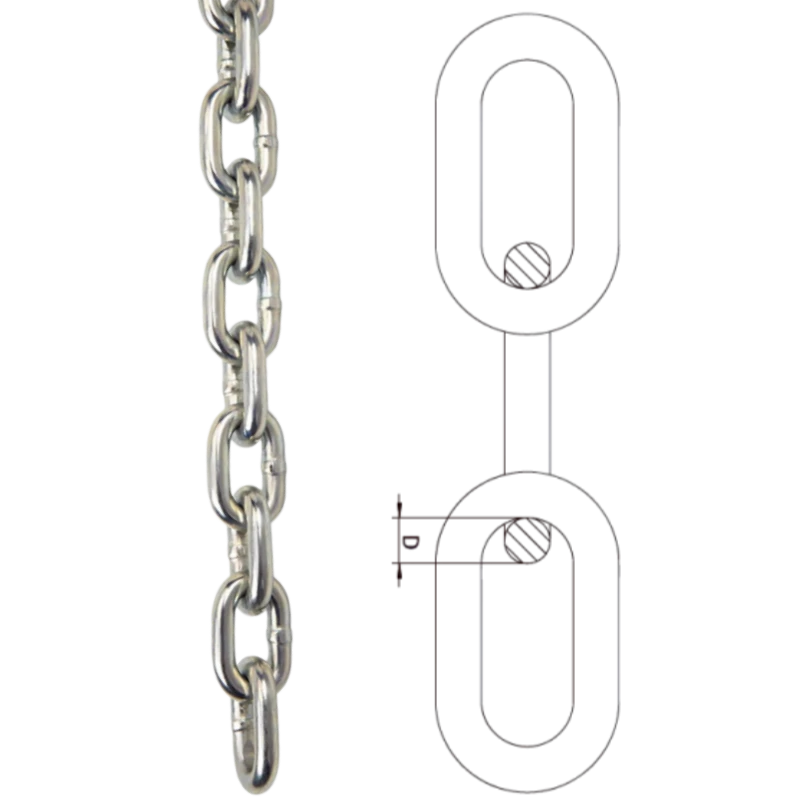
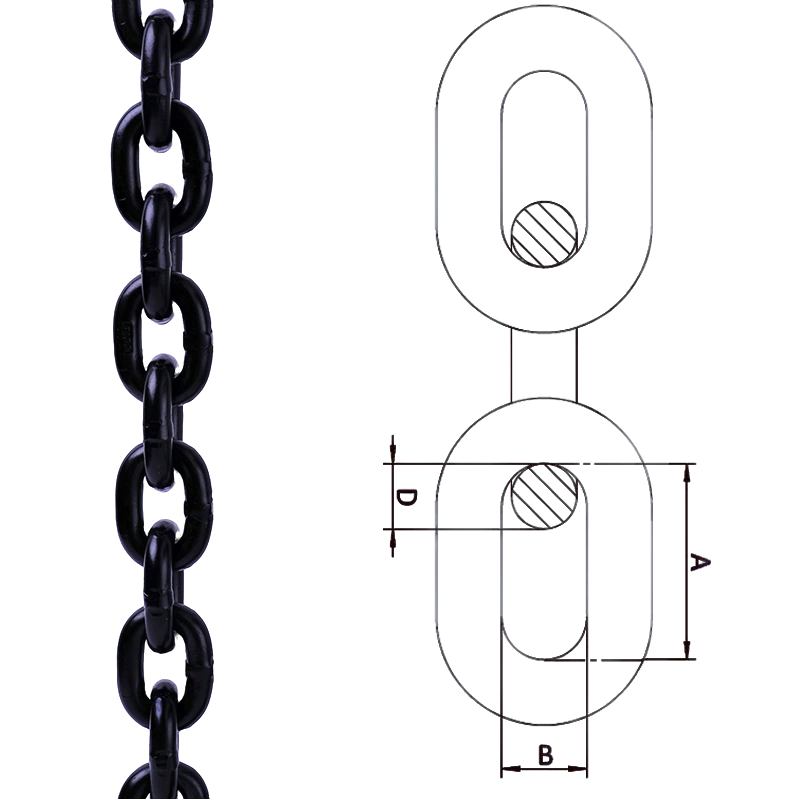
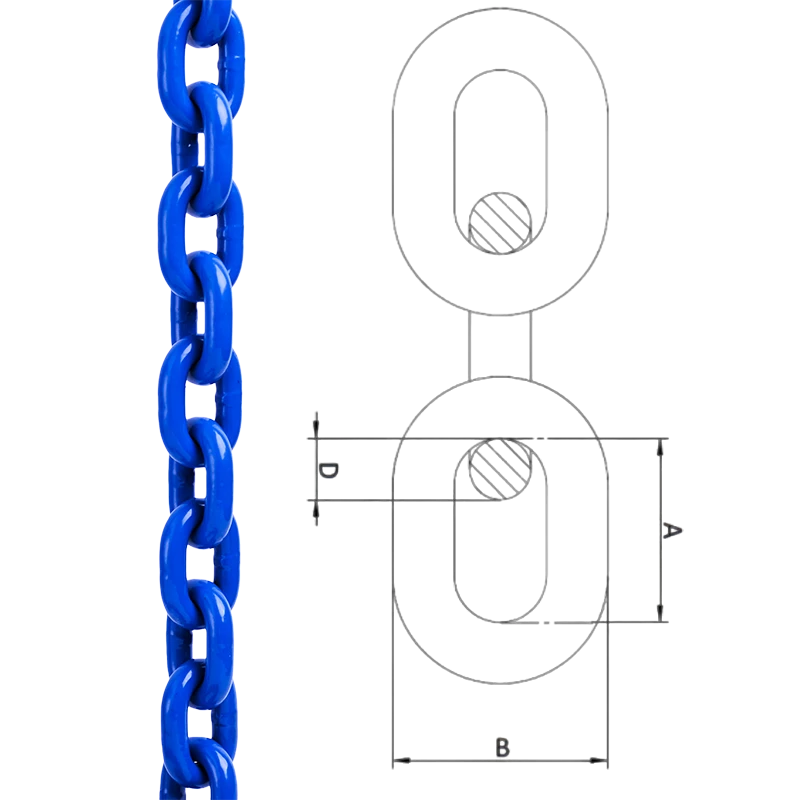
DIAGRAMS of PROOF COIL CHAIN
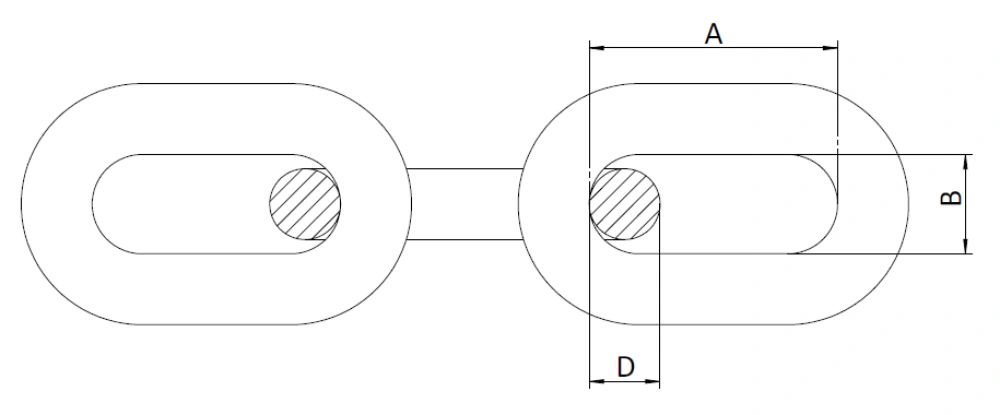
Proof Coil Chain Specs
| NOMINAL SIZE | MATERIAL DIAMETER | WORKING LOAD LIMIT | PROOF TEST(MIN) | BREAKING FORCE MIN | INSIDE LENGTH | INSIDE WIDTH | |||||||
| MM | IN | MM | IN | KG | LBS | KN | LBS | KN | LBS | MM | IN | MM | IN |
| 4.0 | 1/8 | 4.0 | 0.156 | 180 | 400 | 3.8 | 800 | 7.2 | 1600 | 23.9 | 0.94 | 6.4 | 0.25 |
| 5.5 | 3/16 | 5.5 | 0.217 | 365 | 800 | 7.2 | 1500 | 14.4 | 3200 | 24.8 | 0.98 | 7.7 | 0.30 |
| 7.0 | 1/4 | 7.0 | 0.276 | 580 | 1300 | 11.6 | 2600 | 23.2 | 5200 | 31.5 | 1.24 | 9.8 | 0.38 |
| 8.0 | 5/16 | 8.4 | 0.331 | 860 | 1900 | 16.9 | 3800 | 33.8 | 7600 | 32.8 | 1.29 | 11.2 | 0.44 |
| 10.0 | 3/8 | 10.0 | 0.394 | 1200 | 2650 | 23.5 | 5300 | 47.2 | 10600 | 35.0 | 1.38 | 14.0 | 0.55 |
| 11.9 | 7/16 | 11.9 | 0.488 | 1680 | 3700 | 32.9 | 7400 | 65.8 | 14800 | 41.5 | 1.64 | 16.6 | 0.65 |
| 13.0 | 1/2 | 13.0 | 0.512 | 2030 | 4500 | 40.0 | 9000 | 80.0 | 18000 | 45.5 | 1.79 | 18.2 | 0.72 |
| 16.0 | 5/8 | 16.0 | 0.630 | 3130 | 6900 | 61.3 | 13800 | 122.8 | 27600 | 56.0 | 2.20 | 20.0 | 0.79 |
| 20.0 | 3/4 | 20.0 | 0.787 | 4800 | 10600 | 94.3 | 21200 | 188.6 | 42400 | 70.0 | 2.78 | 25.0 | 0.98 |
| 22.0 | 7/8 | 22.0 | 0.866 | 5810 | 12800 | 114.1 | 25600 | 228.2 | 51200 | 77.0 | 3.03 | 27.5 | 1.08 |
| 25.0 | 1 | 26.0 | 1.020 | 8140 | 17900 | 159.1 | 35800 | 318.2 | 71600 | 90.9 | 3.58 | 31.7 | 1.25 |
DESIGN of GRADE 30 PROOF COIL CHAIN
GRADE
- 30
FINISH
- Self-Colored Finish Or Galvanized Finish
STANDARDS
- Meets or exceeds OSHA, Government, NACM, and ASTM specification requirements
ORIGIN
- Made in China
APPLICATION
- Used for a variety of applications
MATERIAL
- Carbon steel
Our Advantages
Flexible Payment
Choose from a range of payment options to suit you such as a 30-day credit account.
Fast Delivery
Enjoy fast delivery with quick processing and timely arrivals for all your orders.
Best Rated
We Are the Highest Rated Lifting Chains Manufacturer in China With 20 Years of Experience & Knowledge
Price Match Guarantee
We are committed to offering the best prices and ensuring you never pay more than necessary.
FAQ
What is Proof Coil Chain?
Proof coil chain is a robust steel chain commonly used in industrial applications for lifting, securing, towing, and other heavy-duty uses. Unlike other chains, proof coil chains feature welded links that undergo heat treatment to enhance their strength and durability. This design makes them a reliable choice for various industries, including construction, agriculture, and logistics.
Welded construction: Links are welded together for superior durability and long-lasting performance.
Heat treatment: This step increases the chain’s strength, allowing it to withstand heavier loads.
Versatility: Proof coil chains are ideal for general lifting, securing cargo, and towing vehicles.
Proof Coil vs High Test Chain: What’s the Difference?
When deciding between proof coil and high test chains, it’s important to understand their differences. Here’s a breakdown of each chain’s features to help you choose the right one for your needs:
-
Proof Coil Chain
-
Designed for light-duty tasks like securing cargo, fencing, and general-purpose use.
-
Affordable and reliable for everyday applications.
-
Lower tensile strength compared to high test chain, making it ideal for lighter jobs that don’t require heavy lifting.
-
-
-
Built for heavy-duty applications, such as construction, towing, and lifting.
-
Higher tensile strength, meaning it can withstand more pressure and heavier loads.
-
Better for construction and industrial jobs, where strength and durability are crucial.
-
What is Proof Coil Chain Made Of?
Proof coil chains are typically made from high-quality carbon or alloy steel. These materials are selected for their ability to handle heavy stress. To ensure the chain’s longevity and performance, manufacturers use heat treatment processes that improve its tensile strength, toughness, and wear resistance.
- Steel composition: Made from carbon steel or alloy steel for superior strength.
- Heat-treated for strength: Heat treatment ensures the chain can handle extreme stress and weight.
- Corrosion resistance: Galvanized steel options are available to resist rust and corrosion in outdoor and marine environments.
The material choice directly impacts the chain’s performance in various applications, including those exposed to harsh environmental conditions.
What is Proof Coil Chain Used For?
Proof coil chains are used across a range of industries, providing reliable solutions for lifting, securing, and towing heavy loads. These chains are often employed in construction, agriculture, and transportation for tasks that demand high strength but also require a degree of flexibility and ease of use.
- Lifting equipment: Proof coil chains are commonly used for hoisting and rigging heavy machinery or materials in construction.
- Securing cargo: They are essential in securing trailers, farm equipment, and materials during transport.
- Towing: Widely used for towing vehicles, including trucks and boats, due to their reliable tensile strength.
What Are the Common Proof Coil Chain Sizes?
Proof coil chains come in different sizes to suit various load capacities and operational needs. Chain size is primarily determined by the diameter of the links, and each size is suited for specific applications, from light-duty tasks to heavy lifting.
- Light-duty sizes: Smaller chains (1/4 inch to 3/8 inch) are used for general purpose, light lifting, and securing lighter loads.
- Heavy-duty sizes: Larger chains (1/2 inch and above) are used in industrial settings for heavy lifting, towing, and securing large equipment.
- Custom sizes: Many manufacturers offer custom link sizes to meet specific business needs, ensuring optimal performance for specialized tasks.
Choosing the right size is essential to ensure the chain’s strength is sufficient for the intended load without being too bulky for easy handling.
How Long Does Proof Coil Chain Last?
The lifespan of proof coil chains depends on usage and maintenance. Regular use in outdoor environments can expose the chain to rust and corrosion, which shortens its lifespan. If properly maintained—by cleaning after use and applying lubricants to prevent rust—proof coil chains can last for many years. They should be inspected regularly for signs of wear and tear, and any damaged links should be replaced promptly.
Can Proof Coil Chains Be Used for Lifting?
Proof coil chains are not designed for lifting heavy loads. While they can lift light loads, for heavy-duty lifting, you should use higher-grade chains like Grade 70 or Grade 80. These chains are specifically engineered for strength and durability under load. Proof coil chains can be used for light lifting tasks but always stay within the working load limit (WLL). For lifting critical loads, always opt for a chain with higher tensile strength.
How Strong is Proof Coil Chain?
The strength of proof coil chain depends on several factors, including the grade of steel used and the link diameter. The strength is often defined by the working load limit (WLL), which indicates the maximum load a chain can handle safely.
- WLL: Working load limits are typically calculated based on the chain’s grade and link diameter.
- Tensile strength: Proof coil chains have high tensile strength, which means they can withstand considerable force before breaking.
- Safety margin: Most chains are designed with a safety factor of 4:1, which ensures a higher margin of safety during use.
Proof Coil Chain vs BBB Chain: What’s the Difference?
While both proof coil and BBB chains are used for heavy-duty tasks, they differ in their construction, strength, and ideal applications.
- Link design: Proof coil chains have round links, which offer more flexibility for general-purpose tasks. BBB chains feature square links, providing higher strength and resilience for heavy-duty lifting and towing.
- Strength: BBB chains are generally stronger than proof coil chains, making them more suitable for tasks that require greater load-bearing capacity.
- Applications: Proof coil chains are ideal for lighter, more flexible tasks, while BBB chains are preferred for securing large loads and heavy machinery.
Why Should Proof Coil Chain Not Be Used for Slings?
Proof coil chains are not suitable for use as slings, particularly in lifting applications, due to their rigidity and lack of flexibility. Slings made from synthetic materials or fabric offer important advantages that proof coil chains cannot provide.
- Lack of flexibility: Slings conform to the shape of the load, providing better stability during lifting, while proof coil chains are rigid and can shift the load unpredictably.
- Surface protection: Slings help protect delicate surfaces from damage, while chains can cause abrasion or harm to the load.
- Shock absorption: Slings absorb shock loads, which helps prevent sudden jerks or tension spikes during lifting, a feature not present in proof coil chains.
How to Choose the Right Proof Coil Chain for Your Business?
Selecting the right proof coil chain involves considering several key factors to ensure it meets your operational needs.
- Load capacity: Ensure that the chain’s working load limit (WLL) matches or exceeds the expected load requirements.
- Environmental factors: If the chain will be exposed to moisture or chemicals, opt for galvanized or coated chains to prevent rust.
- Chain length and size: The size of the chain links and the total length should align with the task requirements, providing adequate strength and maneuverability.
Choosing a proof coil chain tailored to your specific needs will optimize safety, reliability, and efficiency in your operations.
How to Maintain Proof Coil Chain for Maximum Lifespan?
Regular maintenance is crucial to prolong the life of proof coil chains and ensure they perform safely and effectively in demanding applications.
- Routine inspections: Check the chain regularly for signs of wear, damage, or deformation in the links.
- Proper cleaning: Clean the chain to remove dirt, rust, or debris, especially if it’s exposed to harsh environmental conditions.
- Lubrication: Apply lubricant to prevent friction and corrosion, particularly in high-use environments.
- Correct storage: Store chains in a dry, protected environment to prevent exposure to corrosive elements when not in use.
By adhering to these maintenance practices, your proof coil chain will continue to perform reliably, reducing downtime and ensuring safety in operations.