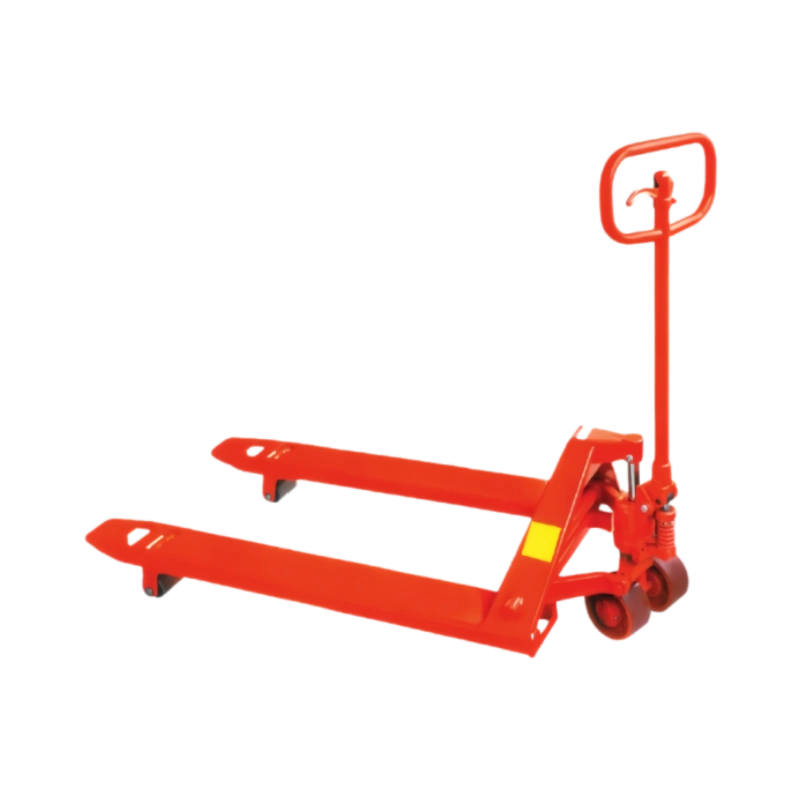
Move standard and non-standard pallets with a truck matched to the load, pallet entry and floor conditions. Powerful Machinery manufactures manual hydraulic pallet trucks in 2,000, 2,500 and 3,000 kg capacities, with multiple fork sizes, lowered heights and wheel materials. Tell us your pallet dimensions, maximum load, surface and order quantity; we’ll recommend a suitable model and confirm the specification before production.
For a useful quotation, include the pallet drawing or dimensions, maximum load, floor condition, travel distance, quantity and destination. We’ll review the information, recommend a suitable manual hydraulic pallet truck and confirm the specification and commercial details with you.
A straightforward choice for routine pallet movement on smooth, level floors. Check the product page for available capacity, fork size and wheel configurations.
Available in 2,000, 2,500 and 3,000 kg capacities, with listed fork lengths from 810 to 1,220 mm and several fork-width options. Nylon, polyurethane and rubber wheel options help match the truck to the floor and operating conditions.
For buyers who need a manual hydraulic truck configured around pallet entry, fork dimensions and wheel material. Send the pallet drawing when the opening or footprint is non-standard.
The ORM-HP range is listed in 2,000, 2,500 and 3,000 kg capacities, with 550 or 685 mm fork widths and 1,100 or 1,200 mm fork lengths. Choose nylon, rubber or polyurethane wheels to suit the application.
A pallet truck that looks right on paper can still be wrong for the job if the forks do not enter the pallet, the wheels do not suit the floor or the operator must move heavy loads too far by hand. Confirm the points below before requesting a quote.
| Check | What to Confirm | Why It Matters |
|---|---|---|
| Load capacity | Maximum pallet weight, including the pallet and packaging | Choose a rated capacity above your actual working load. Never exceed the truck’s stated capacity. |
| Pallet entry | Pallet opening height, entry direction and bottom-board layout | The lowered forks and load rollers must be able to enter and move through the pallet without obstruction. |
| Fork dimensions | Overall fork width and fork length | The forks should support the load securely without extending too far beyond the pallet or leaving it unstable. |
| Travel and frequency | Travel distance, number of moves per shift and floor slope | A powered pallet truck may be more suitable for frequent or long-distance moves. Standard manual models work best on smooth, level floors. |
| Wheel material | Floor condition, debris, noise requirements and rolling resistance | Nylon, polyurethane and rubber wheels perform differently. Choose based on the full working environment rather than one feature alone. |
| Operating environment | Indoor or outdoor use, moisture, washdown, cold storage and corrosive exposure | Stainless steel, galvanized finishes, special seals or other protective features may be required. Confirm availability before ordering. |
Share the pallet drawing and operating details. We use them to narrow the capacity, fork and wheel configuration before the order is confirmed.
Current product specifications include several capacities, fork widths, fork lengths, lowered heights and wheel materials. Ask us to confirm the exact combination available for your order.
A complete request reduces back-and-forth. Include quantity, destination, required documents and any packing or labeling instructions along with the technical details.
Manual pallet trucks are commonly used for short horizontal moves where loads remain near floor level: receiving and dispatch areas, production lines, stockrooms, warehouses, retail backrooms and truck loading areas. The correct configuration depends on the pallet, floor, distance and handling frequency. For ramps, rough surfaces or intensive travel, describe the route before selecting a truck.
A pallet truck is a wheeled material-handling device with low forks that enter a pallet, lift it slightly and move it horizontally. Manual models use a hydraulic pump for lifting and are moved by the operator.
In everyday material handling, the terms are usually used for the same equipment. “Pallet truck” is common internationally, while “pallet jack” is especially common in North America.
Use the maximum actual pallet weight, including packaging, and select a truck with a suitable rated capacity. Capacity alone is not enough: confirm load distribution, fork support and operating conditions with the supplier.
Measure the pallet openings, overall footprint and entry direction. The forks must enter freely and support the load correctly. Send a pallet drawing for non-standard pallets.
Choose after checking the floor finish, debris, noise requirements, rolling resistance and operating environment. Nylon, polyurethane and rubber each suit different conditions; ask us to match the option to your route.
Electric travel can reduce operator effort for frequent moves, longer routes or heavier daily workloads. Before choosing one, review travel distance, gradients, charging access, duty cycle and local operator-training requirements.
Send pallet dimensions and entry, maximum load, required fork dimensions and lowered height, floor and route conditions, wheel preference, quantity, destination, required documents and any packing or labeling instructions.
After downloading the product catalogue, our dedicated technical experts will provide you with one-on-one service.