
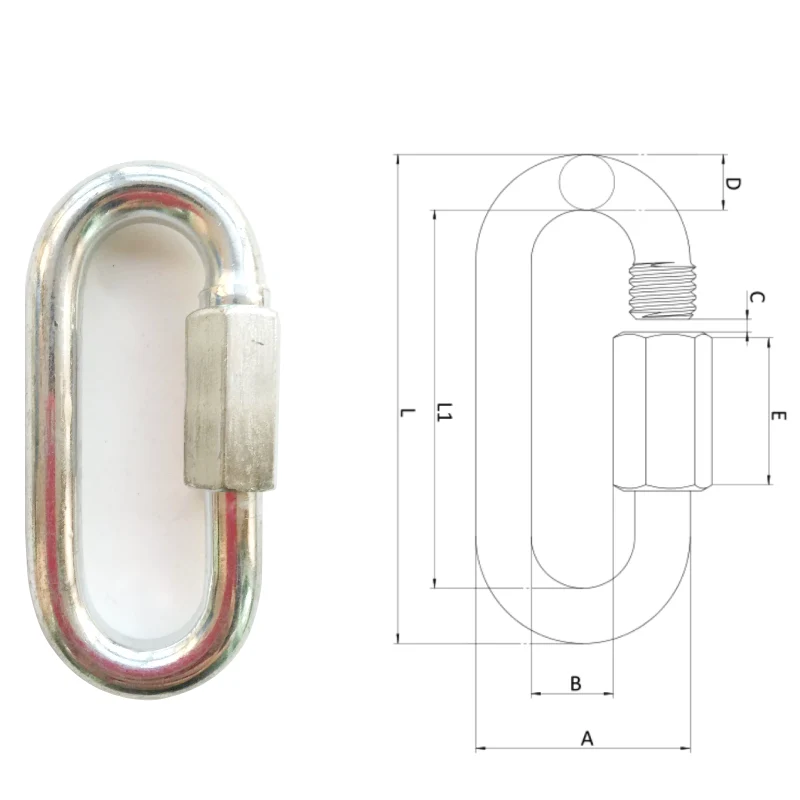
Standard Quick Link Sizes and Dimensions
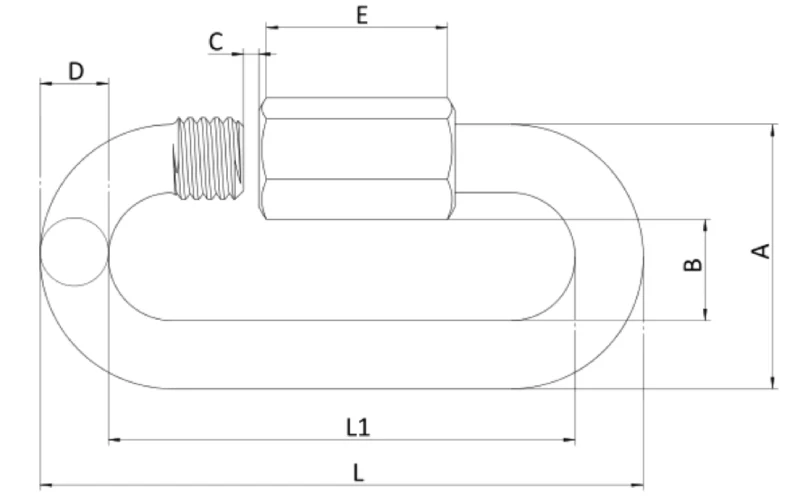
| SIZE | A | B | C | D | L | L1 | E | WEIGHT |
| MM | MM | MM | MM | MM | MM | MM | MM | KG/100PCS |
| 3.5 | 17 | 10 | 5 | 3.5 | 36 | 29 | 11 | 0.8 |
| 4 | 19.5 | 11.5 | 5.5 | 4 | 39.5 | 31.5 | 12.5 | 1.2 |
| 5 | 23 | 13 | 6.5 | 5 | 48.5 | 35.5 | 16 | 2.1 |
| 6 | 26.5 | 14.5 | 7.5 | 6 | 57 | 45 | 19 | 3.5 |
| 7 | 30 | 16 | 8.5 | 7 | 66 | 52 | 21.5 | 5.45 |
| 8 | 33.5 | 17.5 | 10.5 | 8 | 74 | 58 | 24 | 7.5 |
| 9 | 37 | 19 | 11 | 9 | 80 | 62 | 26 | 10.5 |
| 10 | 40.5 | 20.5 | 12 | 10 | 89 | 69 | 29 | 13.5 |
| 12 | 47.5 | 23.5 | 15 | 12 | 104.5 | 80.5 | 33 | 22.8 |
| 14 | 54.5 | 26.5 | 17 | 14 | 121 | 93 | 38.5 | 35 |
| 16 | 61.5 | 29.5 | 19 | 16 | 140 | 108 | 45 | 50 |
Use the table as a dimensional reference when matching a quick link to chain, an eye, a thimble or another connection point. Check the wire diameter, internal length and width, sleeve dimensions and gate opening against the mating parts.
Dimensions alone do not establish strength or suitability: the quotation and product documentation must identify the material, finish, item number and any applicable working-load limit for the exact model.
Need a drawing for approval? Include the required chain or cable diameter, available clearance and any maximum outside dimensions in your RFQ. We can review the standard range and flag where a long, wide-jaw, delta or pear-shaped link may provide a better fit.
Products Diagrams
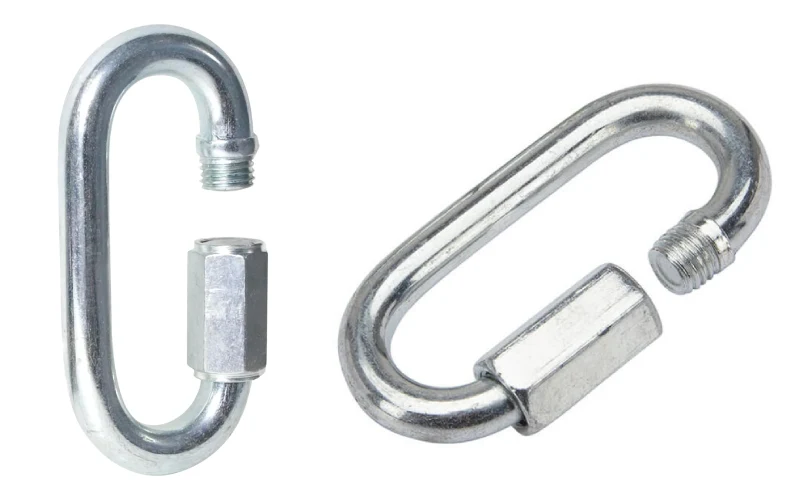
How to Choose the Right Threaded Quick Link?
A quick link should be selected as part of the complete connection, not as an isolated piece of hardware. Start with the components it must pass through, then check service load, environment, frequency of opening and the documentation required by your customer or market.
Match the Link to the Connected Components
Measure the narrowest opening in every chain link, eye, thimble or fitting that the connector must enter. Confirm that the quick link’s gate opening clears those parts and that the connected components can sit inside the body without bearing on the threaded sleeve. If the standard oval shape is too narrow, ask about a wide-jaw, long, delta or pear configuration rather than forcing the connection.
Check the Required Load and Use Classification
State the maximum service load and whether the connection is for general utility, cargo securement, marine equipment, a static installation or another defined use. The lowest-rated compatible component governs the assembly. Do not use the dimensions table as a load chart, and do not substitute breaking load for working load. If your application involves lifting, fall protection, climbing, towing or shock loading, tell us before quotation so the request can be screened for the correct product class.
Choose the Material and Finish for the Environment
For dry indoor or general outdoor service, a zinc-plated carbon-steel option may provide a practical balance of cost and corrosion protection. Stainless steel is often considered for wet, coastal, food-processing or marine environments, but the exact grade and finish matter. Specify salt exposure, chemicals, temperature, wash-down conditions and dissimilar-metal contact so the material can be reviewed instead of chosen by appearance alone.
Carbon Steel and Stainless Steel Options
Carbon steel and stainless steel are not interchangeable in every application. Carbon steel can deliver an economical connection and accepts protective coatings, while stainless steel offers inherent corrosion resistance for more demanding environments. Final performance depends on the actual grade, manufacturing method, dimensions, finish and service conditions.
| Option | Best considered for | Information to confirm |
|---|---|---|
| Zinc-plated carbon steel | General industrial, agricultural, transport, and indoor/outdoor connection applications | Steel grade, plating type and thickness, WLL/use limit, and coating compatibility |
| Stainless steel | Wet, coastal, marine, wash-down, or corrosion-sensitive service environments |
Exact stainless grade, finish/passivation treatment, WLL/use limit, chemical compatibility, and galvanic compatibility |
If you require 304, 316 or another named grade, put that requirement on the purchase specification. Powerful Machinery will confirm availability for the requested size. A generic “stainless steel” description should not be used as a substitute for a verified material designation.
Typical Applications for Standard Quick Links
Standard threaded quick links are suited to connections that may need to be assembled without welding and reopened for maintenance. Typical requests include joining compatible utility chain, attaching chain to an eye or ring, connecting cable or wire-rope assemblies through an appropriate thimble, and securing accessories in marine, agricultural, workshop and transport settings.
• General-purpose chain connections and repair points
• Cable and wire-rope connections using compatible eyes or thimbles
• Marine and outdoor equipment where the selected material suits the environment
• Agricultural, workshop and maintenance assemblies
• Cargo or trailer hardware only when the exact item and complete assembly are rated for that use
• OEM equipment connections defined by an approved drawing
These products are industrial screw links, not bicycle-chain master links. They are also not automatic snap hooks or carabiners: opening and closing requires turning the threaded sleeve. For frequently opened connections, compare the required security, clearance and operating speed before choosing the connector type.
How to Install a Standard Quick Link?
1. Verify the item number, dimensions, material, finish and stated use limit against the approved order.
2. Inspect the body, sleeve and threads. Do not install a part with cracks, distortion, severe corrosion, damaged threads or an unreadable required marking.
3. Open the sleeve only far enough to pass the compatible components through the gate. Do not pry the body apart.
4. Seat the connected components in the body, clear of the sleeve and threads. Avoid side loading, twisting and point contact.
5. Close the sleeve until the threads are fully engaged and follow the manufacturer’s written tightening instruction for that model.
6. Confirm the connection, clearance and load path before service. Recheck the closure as required by the operating procedure.
Do not weld, grind, heat, bend, plate or otherwise modify a quick link unless the modification is covered by an approved manufacturing specification. Field modification can change material properties, thread fit and load capacity.
Inspection and Replacement
Inspect the quick link before use and at intervals appropriate to the application and environment. Clean the part sufficiently to see the body, closure and threads. Compare questionable dimensions with the original manufacturer’s data rather than judging the part only by feel.
Remove the quick link from service if you find:
• cracks, nicks, gouges or sharp wear marks
• bent, twisted, stretched or visibly distorted geometry
• thread damage, cross-threading or a sleeve that will not close correctly
• significant corrosion, pitting or loss of section
• heat damage, welding, unauthorized coating or other modification
• missing or illegible identification where identification is required
• any condition outside the manufacturer’s stated acceptance criteria
Do not repair a damaged quick link by forcing the body back into shape or chasing damaged threads for continued service. Quarantine the item and replace it with a correctly specified connector. If the cause of damage is unclear, inspect the mating hardware and the load path before installing a replacement.
Manufacturing, Quality and Documentation
For an industrial buyer, a useful quotation should identify more than diameter and finish. Ask for an item number, controlled drawing, material designation, dimensional tolerances, manufacturing route, surface treatment and the test or inspection documents that apply to the order. Requirements should be agreed before production, especially when the connector will be incorporated into an OEM assembly.
Available documentation depends on the product and order. State whether you need a material certificate, dimensional report, coating report, inspection record, sample approval, batch identification or third-party testing. Powerful Machinery will confirm what can be supplied and identify any cost, sample or lead-time implications in the quotation.
OEM and Bulk Quick Link Supply
Powerful Machinery supports distributors, importers, hardware brands and equipment manufacturers that need repeatable supply. Standard sizes can be quoted from the published range, while OEM requests can be reviewed for dimensions, material, finish, marking, packaging and document control. Feasibility, minimum order quantity and lead time depend on the final specification.
Include these details for a faster quotation:
• required size or marked-up drawing
• connected chain, cable, eye or fitting dimensions
• maximum service load and application classification
• material grade and surface-finish requirement
• operating environment and corrosion exposure
• quantity, packaging, marking and delivery destination
• required inspection, test and compliance documents
Standard Quick Link FAQs
What is a standard quick link?
A standard quick link is an oval metal connector with a threaded sleeve. The sleeve opens to admit compatible chain, cable eyes, rings or fittings and screws closed to form a secure, semi-permanent connection. It differs from a snap hook or carabiner because it does not use a spring-loaded gate.
What sizes are available?
The current dimensional range covers nominal sizes from 3.5 mm to 16 mm. Availability can vary by material and finish, so confirm the exact size, item number and specification in the quotation.
Are stainless steel quick links available?
Stainless-steel options can be reviewed for corrosion-sensitive service. Specify the required grade—such as 304 or 316—rather than requesting generic stainless steel, and ask us to confirm availability, finish and documentation for the selected size.
How do I choose the correct quick link size?
Check the gate opening against every component the link must pass through, then confirm the internal dimensions, service load, material, environment and use classification. The mating chain or fitting must sit in the body without loading the threaded sleeve.
What is the working load limit?
Working load limit is model-specific and cannot be determined from diameter alone. Use only the WLL stated for the exact item in Powerful Machinery’s approved quotation or product documentation. If no WLL is supplied, do not assume one from a similar-looking product.
Can standard quick links be used for overhead lifting?
No. The standard quick links covered by this page are general-purpose connecting hardware and are not for overhead lifting or personnel support. Ask for purpose-designed, rated and documented lifting hardware when the application involves suspended loads.
What is the difference between a quick link and a carabiner?
A quick link closes with a threaded sleeve and is normally chosen for a more secure, less frequently opened connection. A carabiner or snap hook uses a hinged gate and is faster to operate. Selection depends on the required rating, security, opening frequency, geometry and applicable standard—not only convenience.
Can I order custom finishes, markings or packaging?
Yes, OEM requests for finish, marking, branding and packaging can be reviewed for bulk orders. Send the drawing, target specification, quantity and market requirements so feasibility, tooling, MOQ and lead time can be confirmed before order placement.
What documents can be supplied with a bulk order?
Document availability depends on the model and purchase specification. Tell us whether you need a material certificate, dimensional report, coating report, inspection record, sample approval or third-party test report. We will list the agreed deliverables in the quotation.
Request a Standard Quick Link Quote
Send your required size, connected-component dimensions, maximum service load, use classification, material or finish, quantity, packaging and documentation needs. Powerful Machinery will review the request and return a product match or an OEM feasibility response with the applicable commercial terms.