For other industrial and marine chain products, browse our chain product range.
If you are comparing cable orders by section, see how long one shackle of anchor chain is before specifying the number of full lengths.
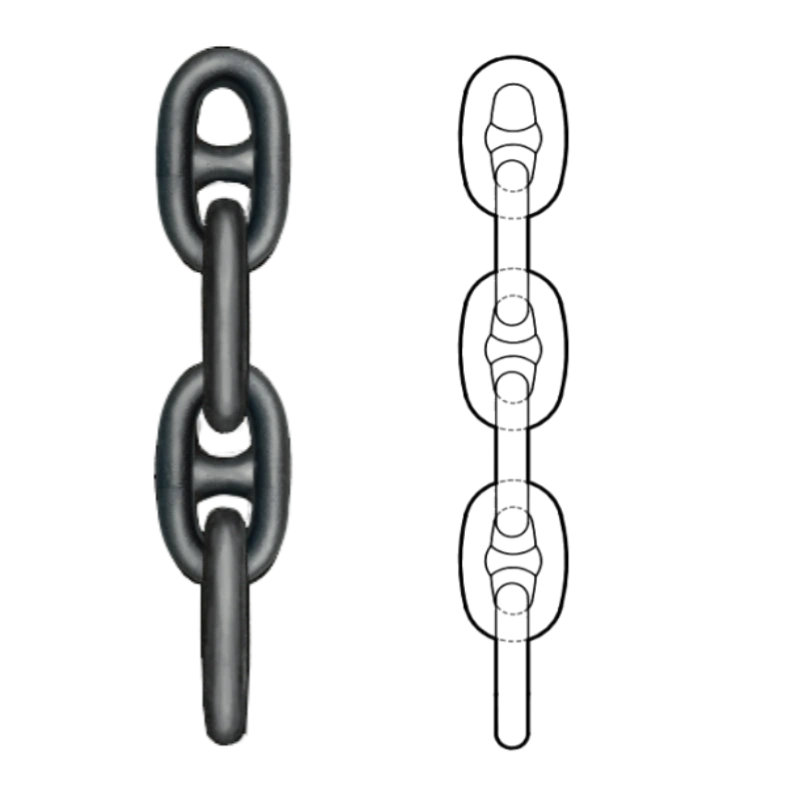
Stud link anchor chain has a central stud across each link. Our catalogue lists AM1, AM2 and AM3 proof and breaking loads for nominal diameters from 17.5 to 130 mm, with chain weight stated per 27.5 m. See the stud link chain specifications for the complete size table. When requesting a quotation, confirm the required diameter, grade, length and joining arrangement.
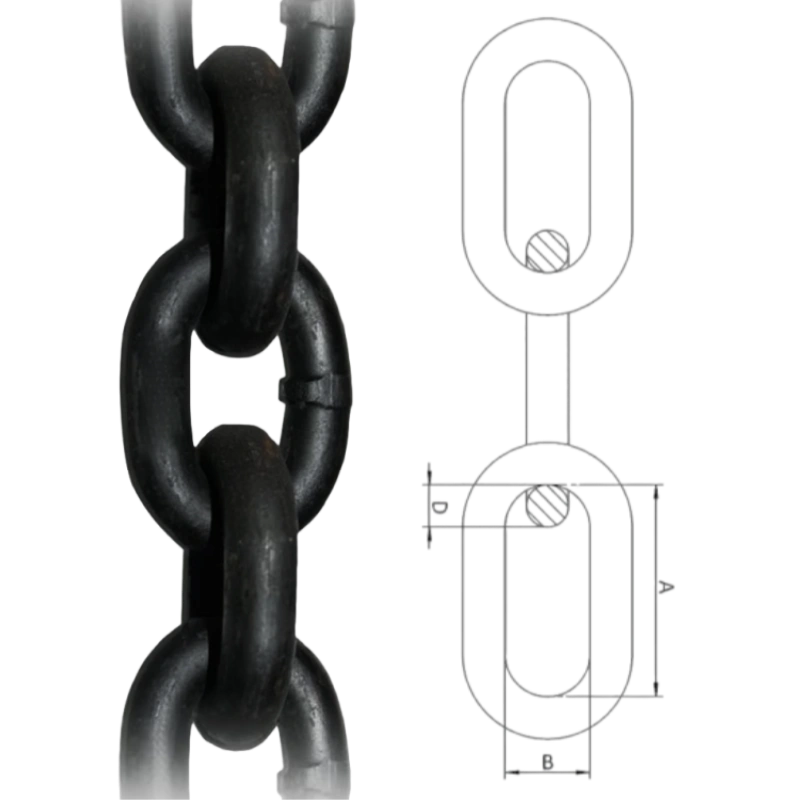
Studless anchor chain uses open links without a central stud. The catalogue lists BM1, BM2 and BM3 proof and breaking loads for nominal diameters from 16 to 50 mm, with weight stated in kg/m. See the studless anchor chain specifications for the full table. Chain type, grade and connection requirements should be checked together rather than selecting by diameter alone.
Send us your anchor chain type, diameter, grade, length, quantity, and joining arrangement, together with the relevant drawings and document requirements. Contact Powerful Machinery for specification review and quotation.
| Specification Item | Stud Link | Studless Link |
|---|---|---|
| Link Geometry | Central stud across each link | Open link without a central stud |
| Catalogue Grades | AM1, AM2, AM3 | BM1, BM2, BM3 |
| Listed Diameter Range | 17.5–130 mm | 16–50 mm |
| Catalogue Weight Unit | kg per 27.5 m | kg per m |
| Key Order Details | Grade, diameter, length and joining form | Grade, diameter, length and connections |
The figures above are selected catalogue examples. Refer to the relevant product table when specifying your exact diameter and grade. For more information about grade terminology, see our anchor chain grades guide.
Anchor chain assemblies may include different joining and end arrangements. Our catalogue illustrates Kenter-shackle and D-type joining-shackle arrangements and identifies components including the common link (C), enlarged link (EL), end link (E), swivel (SW), joining shackle (JS) and anchor shackle (AS).
When requesting a quotation, provide the required connection sequence, mating dimensions and any relevant drawing or specification. General shackle products are a separate product family and should not automatically be treated as replacements for anchor-chain joining components.
For replacement chain, include clear photographs of existing markings and connections together with any available dimensional drawing. This helps us compare the requested chain and connection arrangement before quotation.
A complete RFQ should include the chain type, nominal diameter, grade, required length, quantity, application, joining arrangement, and end connections. Attach any vessel drawing, project specification, or documentation requirements that apply to the order.
If specific inspection, witnessed testing, coating, documentation, or delivery requirements apply, state them in the RFQ so they can be reviewed against the requested configuration.
Anchor chains and connecting components should remain accessible for inspection during storage and service. Check accessible links and connections for corrosion, deformation, wear and other visible damage according to the applicable vessel or project maintenance procedure. For a more detailed discussion, see our anchor chain maintenance guide.
Anchor chains and connecting components should remain accessible for inspection during storage and service. Check accessible links and connections for corrosion, deformation, wear and other visible damage according to the applicable vessel or project maintenance procedure. For a more detailed discussion, see our anchor chain maintenance guide.
No. Diameter alone is not enough to determine interchangeability. Chain type, grade, proof and breaking loads, link geometry, joining components and the applicable vessel or project specification should all be checked before selecting a replacement.
No. The proof load shown in the catalogue is a specified test value. It should not be treated as the working load limit of the complete anchoring system. The breaking load is also a separate value.
Provide the existing chain type, nominal diameter, grade if known, required length and connection arrangement. Clear photographs of chain markings, end connections and joining components, together with an available dimensional drawing, are also useful for specification review.
Not completely. Diameter and grade are key specifications, but the order should also define the chain type, required length, joining arrangement, end connections and any applicable testing or documentation requirements.
The catalogue presents stud link chain weight per 27.5 m and studless chain weight in kg/m. Use the unit shown in the corresponding product table when comparing sizes or preparing an RFQ.
After downloading the product catalogue, our dedicated technical experts will provide you with one-on-one service.