

HSZ-T HAND CHAIN BLOCK SPECIFICATIONS
Select the rated capacity based on the maximum verified suspended load, not an estimated or typical load. The suspension point, supporting structure, and lifting attachments must also be suitably rated for the intended lift. The values below reproduce the currently available HSZ-T data by capacity; confirm the final model code and approved technical datasheet before ordering.
| Model | HSZ-T12 | HSZ-T1 | HSZ-T12 | HSZ-T2 | HSZ-T3 | HSZ-T5 | HSZ-T10 |
| Capacity(t) | 0.5 | 1 | 1.5 | 2 | 3 | 5 | 10 |
| Standard lift(m) | 2.5 | 2.5 | 2.5 | 3 | 3 | 3 | 3.5 |
| Test load(t) | 0.75 | 1.5 | 2.25 | 3 | 4.5 | 7.5 | 12.5 |
| Min.distance between hooks(mm) | 255 | 306 | 368 | 444 | 486 | 616 | 700 |
| Chainpull to lift full load(n) | 221 | 304 | 343 | 314 | 343 | 383 | 392 |
| No.of load chain fall lines | 1 | 1 | 1 | 2 | 2 | 2 | 4 |
| Diameter of load chain(mm) | 6 | 6 | 8 | 6 | 8 | 10 | 10 |
| Net weight(kg) | 8 | 10 | 16 | 14 | 24 | 36 | 68 |
| Gross Weight(kg) | 10 | 13 | 20 | 17 | 28 | 45 | 83 |
| Packing measurement L×W×H(cm) | 28×21×17 | 30×24×18 | 34×29×20 | 33×25×19 | 38×30×20 | 45×35×24 | 60×50×28 |
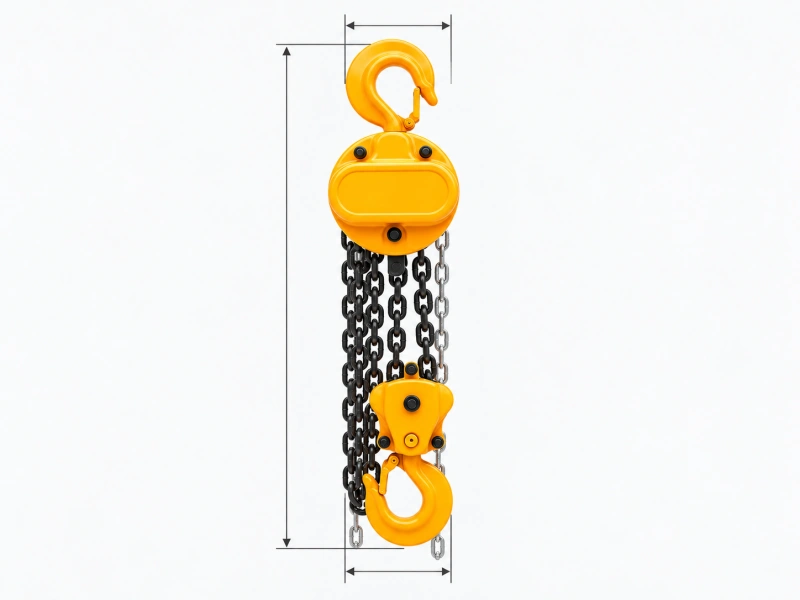
The HSZ-T is part of our manual lifting equipment range. For a broader comparison of manual chain-hoist types and available series, review our chain block range. To request an HSZ-T quotation, provide the required rated capacity, lift, available headroom, suspension method, operating environment, and order quantity.
Data Note: Rated capacity and lift must be confirmed on the product nameplate and approved order documents. Non-standard lifts, alternative suspension arrangements, and other options should be quoted as order-specific configurations rather than assumed from this standard table.
KEY PRODUCT FEATURES
- Manual hand-chain operation for applications where powered lifting is unnecessary.
- Alloy steel load chain with a separate galvanized hand chain.
- Heat-treated, drop-forged upper and lower hooks with safety latches.
- Double-pawl mechanical load brake.
- Compact enclosed body for transport, installation, and storage.
- Hook-suspended configuration that may be used with a correctly selected trolley or other approved support arrangement, subject to configuration confirmation.
Product materials, surface finishes, chain specifications, hook construction, brake configuration, and required documentation can be confirmed according to the selected HSZ-T model and order requirements.
HOW TO SELECT THE RIGHT CONFIGURATION
Rated Capacity
Choose a rated capacity equal to or greater than the maximum verified suspended load. Include the weight of below-the-hook lifting devices and attachments when determining the total suspended load. Never use the test load as an operating capacity.
Lift and Headroom
Specify the required vertical hook travel and check the minimum hook-to-hook distance against the available headroom. If the standard lift is insufficient, request a non-standard lift as an order-specific option and confirm the resulting chain length, hand-chain length, unit weight, storage arrangement, and packaging.
Suspension and Supporting Structure
State whether the hoist will be suspended from a fixed rated point, beam trolley, monorail, or crane hook. Every support, connector, and trolley must be compatible with the hook geometry and suitably rated for the intended load. Review our manual trolley options when horizontal travel is required.
Operating Environment
Specify the temperature range, moisture or water exposure, dust, corrosive conditions, and whether the hoist will be used indoors or outdoors. A standard configuration should not be assumed suitable for corrosive, marine, explosive, or unusually hot or cold service. These conditions require written confirmation and, where applicable, a purpose-designed configuration.
APPLICATIONS AND OPERATING LIMITS
The HSZ-T series is intended for controlled manual vertical lifting in manufacturing, construction, warehouses, equipment installation, and maintenance work. It is suitable where portability and independence from a power supply are more important than high lifting speed or continuous production duty.
- Use the hoist only from a secure, suitably rated suspension point.
- Keep the load line vertical and prevent side pulling.
- Do not exceed the rated capacity or use the hoist to lift people.
- Do not operate a damaged hoist, a twisted load chain, or a hook with a missing or defective latch.
- Keep personnel clear of suspended loads and follow the approved lifting plan and site procedures.
If the task requires pulling, tensioning, or angled positioning rather than a straight vertical lift, compare a lever hoist and chain block before selecting the equipment.
INSPECTION, CARE AND STORAGE
Before use, inspect the hoist body, hooks, latches, load chain, hand chain, and suspension connection for visible damage, distortion, excessive wear, corrosion, and abnormal movement. Run the unloaded hoist through a short lifting and lowering cycle where permitted by the approved operating instructions, and verify that the brake functions correctly. A pre-use check does not replace periodic inspection by a competent person.
Use the detailed chain block inspection checklist for inspection points and recordkeeping. Follow our specified cleaning, lubrication, and brake-care procedures, and complete the required inspection and functional checks before returning the hoist to service. For longer service life, follow the approved chain block maintenance practices and keep the hoist clean, dry, unloaded, and properly organized during chain block storage and care.
Information to Include in Your RFQ
- Required rated capacity
- Required lift, including any non-standard lift requirement
- Quantity
- Hook-suspended or trolley-mounted suspension
- Beam flange width and profile when a trolley is required
- Available headroom and any dimensional limits
- Operating environment and expected lifting frequency or service conditions
- Required test, inspection, marking, documentation, and packaging
- Destination country and delivery terms
For supplier qualification, documentation, and production-review criteria, see our guide to evaluating chain hoist manufacturers.
FAQ
What Is an HSZ-T Hand Chain Block Used For?
It is used for controlled manual vertical lifting from a suitably rated overhead suspension point. Typical applications include equipment installation, workshop handling, warehouse maintenance, and construction work where powered lifting is unnecessary.
Which Rated Capacities Are Available?
The HSZ-T hand chain block is available in rated capacities of 0.5, 1, 1.5, 2, 3, 5, and 10 tonnes. Confirm the required capacity and corresponding model code in the approved quotation and product documentation.
Can the HSZ-T Be Supplied With a Non-Standard Lift?
Non-standard lifts may be available as order-specific configurations. State the required hook travel when requesting a quote so that the load-chain length, hand-chain length, unit weight, headroom, storage requirements, and packaging can be confirmed.
Can a Hand Chain Block Be Used for Side Pulling?
A standard hand chain block is intended for controlled vertical lifting and should not be used for side pulling. Side pulling can impose unintended loads on the hoist body, load chain, hooks, and suspension. For pulling, tensioning, or angled positioning, determine whether a lever hoist is the appropriate equipment type for the application.
What Must Be Checked Before Use?
Check the suspension, hoist body, hooks, latches, load chain, hand chain, and brake function. Verify that the load is within the rated capacity, the load chain is correctly seated and not twisted, and the lifting path is clear. Remove the hoist from service if damage, abnormal operation, or an unresolved inspection finding is identified.